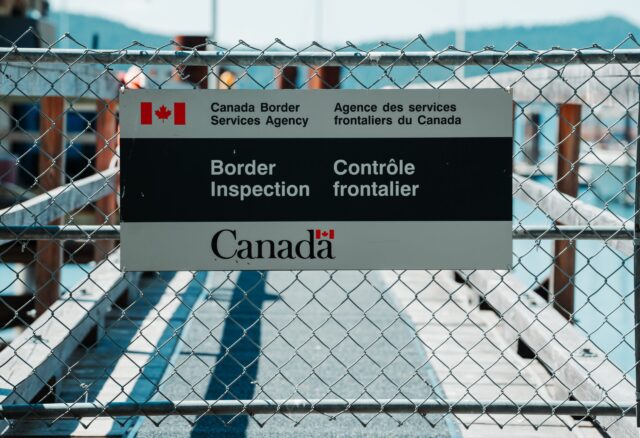
Donald Trump announced Monday that the United States will raise tariffs on Canadian automobiles, steel, automotive parts and trucks to 50% beginning Jan. 1, 2027, escalating a trade dispute that erupted after U.S.-Canada negotiations collapsed last week.
Trump said the new tariffs would apply to “all Cars, Trucks, both large and small, Automotive Parts, and Steel,” and urged companies to move production to the United States to avoid the duties.
“Build in the U.S. and there are ZERO TARIFFS,” Trump wrote on Truth Social. “Canada will be treated like a State no longer!”
The political news that affects your wallet, your rights and your vote, broken down in plain language. Free in your inbox.
The announcement gives the two countries roughly four months to reach another agreement before the higher tariffs take effect, but both governments have so far taken a hard line following the collapse of negotiations.
Trump escalates Canada trade fight
A 50% U.S. tariff on roughly $20 billion worth of Canadian imports took effect Saturday after Washington and Ottawa failed to finalize a trade agreement.
The tariffs came after Trump had temporarily delayed the duties to give negotiators additional time to reach a deal.
The negotiations ultimately broke down, with U.S. and Canadian officials blaming each other for last-minute changes and demands that prevented an agreement.
Trump’s latest announcement expands the pressure on Canada’s automotive and steel industries and could affect companies whose supply chains stretch across the U.S.-Canada border.
Trump framed the four-month delay as an opportunity for Canada to change its approach.
Canada prepares retaliation
Canadian Prime Minister Mark Carney said Saturday that Ottawa would respond to the latest U.S. tariffs with dollar-for-dollar retaliation.
Canadian tariffs on American steel, dairy products, appliances, agricultural equipment, pulp and paper, and electronics are scheduled to take effect Sept. 8.
“It is an attack in a war,” Carney said in French during remarks on Parliament Hill. “It’s not a good choice. We want a global accord between the two countries.”
Carney has blamed Washington for the collapse of negotiations, saying last-minute changes to U.S. proposals made an agreement unacceptable to Canada.
The Canadian government had offered to remove some retaliatory tariffs on U.S. goods in exchange for significant reductions in American tariffs on Canadian products.
The two sides failed to reach an agreement.
Ontario premier urges tougher response
Ontario Premier Doug Ford called for an aggressive Canadian response to Trump’s latest move.
“We need to throw everything in the kitchen sink at them,” Ford told a local Ottawa radio station.
Ford accused Trump of acting like a “bully” and sharply criticized Trump’s approach to Canada.
Ontario is particularly exposed to disruptions in U.S.-Canada trade because of its major automotive and manufacturing industries.
The province is home to numerous plants and suppliers that operate within integrated North American supply chains, making tariffs on vehicles and automotive parts especially consequential for businesses on both sides of the border.
Republican senator calls tariffs a mistake
Trump’s latest escalation also drew criticism from within his own party.
Sen. Susan Collins, R-Maine, called the new tariffs “a mistake” and said she had recently spoken with Canada’s ambassador about trade barriers affecting U.S. agricultural products.
Collins said Maine businesses and producers could be hurt if Canadian goods and products connected to the state’s economy face tariffs.
“We produce a lot of meat, our blueberries, our potatoes, our lobster, our lumber, that is processed across the border,” Collins said Monday at an annual parade in Maine.
“If it comes back with a huge tariff on it, perhaps as much as 50 percent, that increases the cost of heating, building homes, and merchants eating our best-known products,” she said.
Collins also called on both governments to return to negotiations, warning that repeated changes in trade policy create uncertainty for businesses.
Auto industry faces new uncertainty
The automotive sector is likely to be among the industries most affected if the 50% tariffs take effect in January.
Vehicles and automotive parts frequently cross the U.S.-Canada border multiple times during the manufacturing process, meaning tariffs can accumulate throughout a supply chain rather than affecting only the final vehicle.
Trump’s announcement also comes as the two countries remain locked in broader negotiations over the future of the United States-Mexico-Canada Agreement, or USMCA.
The trade agreement, negotiated during Trump’s first administration, governs much of the economic relationship between the three North American countries.
Any prolonged dispute could complicate efforts to preserve the agreement and increase uncertainty for manufacturers planning investments and production.