Poli Alert Politics & Civics
Related Articles



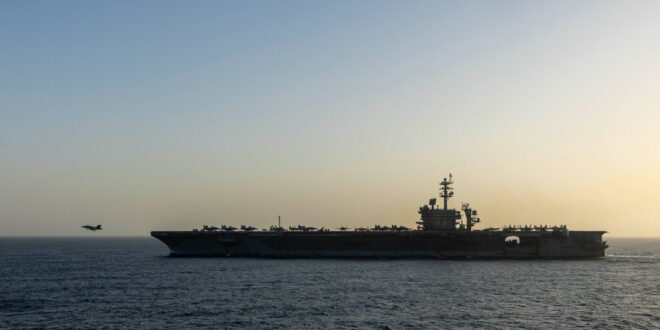
The USS Abraham Lincoln is leaving the Middle East after a nine-month deployment, sending roughly 5,000 sailors and Marines back toward the United States as another American aircraft carrier takes over its mission.
The Japan-based USS George Washington has arrived in the Middle East to replace the Lincoln, which has spent months at sea supporting U.S. military operations in the region.
The Lincoln’s departure comes after its extended deployment drew growing concern from family members and lawmakers over the mental health of sailors, sanitary conditions and reported food shortages aboard the carrier.
The carrier left San Diego on Nov. 21. Its deployment was extended after the war with Iran began in February, significantly increasing the crew’s workload. The Lincoln served as a launch platform for thousands of aircraft sorties supporting U.S. strikes during the conflict.
The carrier could take roughly three weeks to return to San Diego.
Families raise concerns over conditions
The extended mission has generated increasing concern among relatives of sailors aboard the Lincoln.
Family members who spoke with Military Times and Stars and Stripes described deteriorating mental health conditions and problems involving food and sanitation.
The reports have also attracted attention on Capitol Hill, particularly as the deployment approached nine months.
Defense Secretary Pete Hegseth and President Donald Trump have pushed back against concerns about the length and conditions of the deployment.
Trump previously dismissed concerns raised by military families, saying the carrier had not been deployed for long enough.
Acting Navy Secretary Hung Cao also criticized media coverage of conditions aboard the ship, describing it as “dishonest.”
The Navy, however, has continued to address concerns about the well-being of the crew.
Navy addresses mental health concerns
U.S. Central Command Adm. Brad Cooper visited the Lincoln over the weekend as concerns about the crew’s health and conditions continued to draw attention.
Cooper acknowledged the difficulties associated with prolonged deployments but did not confirm specific problems aboard the carrier.
“Deployment at sea is uniquely challenging and tough, and every single one of us, including me, reacts to stressors in different ways,” Cooper said.
Cooper also emphasized that mental health should be treated as an important component of overall health.
“I’ve long believed that mental health is another aspect of individual health and requires our attention just like physical health and spiritual health,” he said.
The Navy said it has not seen an increase in reported suicide attempts or suicidal ideation aboard the Lincoln.
The service is separately investigating an Aug. 3 incident in which a sailor went overboard and was later recovered.
The Navy has not publicly said what caused the incident.
Extended deployment followed Iran war
The Lincoln’s unusually long deployment was initially tied to its scheduled mission but was extended as the United States became directly involved in military operations against Iran.
The carrier became a major platform for U.S. air operations, launching thousands of aircraft flights in support of strikes during the conflict.
The additional operational demands placed on the crew came after months at sea and limited opportunities for sailors to return home.
The arrival of the USS George Washington now allows the Navy to rotate the Lincoln’s crew out of the region.
The transition also comes as the United States continues to maintain a significant military presence in the Middle East.