

President Donald Trump on Tuesday abandoned his proposal to impose a 20% fee on all cargo ships passing through the Strait of Hormuz, instead announcing that the United States will enforce a blockade targeting only vessels connected to Iran.
The reversal came one day after Trump unveiled the sweeping transit fee, a proposal that drew criticism from U.S. allies and members of his own party amid escalating tensions with Iran.
In a post on Truth Social, Trump said the strategic waterway would remain open to global commerce while restricting only Iranian shipping.
“The Strait of Hormuz will be open to ALL Ship traffic except for Iran,” Trump wrote. “We will have a FULL Blockade, but only on Ships coming to and from Iranian ports, or carrying anything have to do with Iranian cargo.”
Trump also said the previously announced transit fee would be replaced by expanded trade and investment agreements with Gulf nations.
“Those Investments will be MASSIVE but, at the same time, extraordinarily good for them, and their future,” the president wrote.
Gulf leaders persuaded Trump to change course
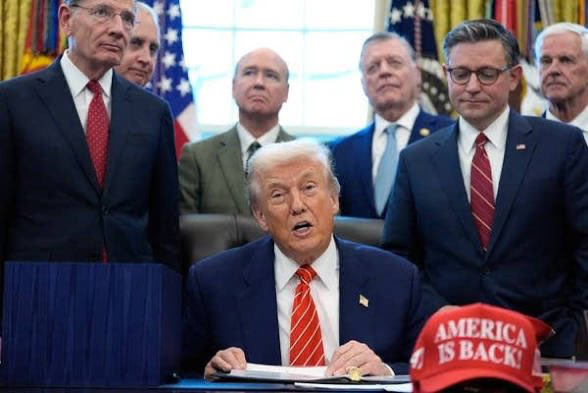
Speaking later Tuesday in the Oval Office, Trump said leaders from Gulf nations urged him to reconsider the proposed shipping fee.
“They said we’d love to do it a different way,” Trump told reporters, recalling Gulf officials telling him, “We would like to invest tremendously in the United States, as opposed to charging a fee.”
Trump said he originally viewed the toll as reimbursement for the U.S. military’s role in protecting one of the world’s busiest maritime trade routes.
“I looked at it as a reimbursement,” Trump said. “But I don’t like the idea of anybody charging a fee.”
Instead, he said Gulf countries would make substantial investments in the United States.
“They’re investing and they’re getting a return on their money,” Trump said. “They’re going to be making massive investments into the United States, and I like that much better.”
Republicans and Democrats questioned proposal
Even before Trump’s reversal, the proposed fee faced skepticism from lawmakers in both parties.
Sen. John Kennedy, R-La., who has generally supported the administration’s Iran policy, questioned whether the United States should impose charges on international shipping.
“I think it’s international waters, and there shouldn’t be a toll put on ships by anyone,” Kennedy said.
Sen. Tim Kaine, D-Va., warned that a broader U.S. effort to police the waterway could further escalate the conflict with Iran.
“If we’re suddenly going to be the guardian of the strait, that’s not going to just be accepted lying down,” Kaine said. “That’s going to put more troops at risk and impose more damage on the American economy and raise the costs of this war.”
Allies oppose restrictions on navigation
International allies also voiced concerns over any effort to impose transit fees through the narrow shipping lane.
British Foreign Secretary Yvette Cooper reaffirmed the United Kingdom’s support for unrestricted commercial navigation.
“Our position remains the same: we support freedom of navigation and we are opposed to tolls in the Strait of Hormuz,” Cooper said.
The Strait of Hormuz serves as one of the world’s most important energy corridors, with a significant share of global oil exports passing through the narrow waterway between Iran and the Arabian Peninsula.
Conflict with Iran continues
The shipping dispute comes as fighting between the United States and Iran has intensified after the collapse of a temporary ceasefire.
The earlier truce failed to resolve disagreements over control of the Strait of Hormuz, a central point of contention throughout negotiations.
Last week, Trump declared the ceasefire was no longer in effect, and U.S. and Iranian forces have since resumed military strikes.
The administration has argued that restricting Iranian shipping is necessary to protect commercial vessels and deter further attacks in the region while allowing international trade to continue uninterrupted.