

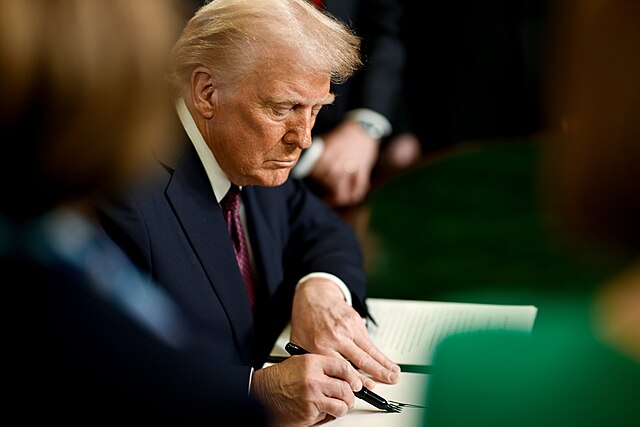
President Donald Trump signed an executive order this week removing longstanding civil service protections from roughly 8,000 federal workers, a move that gives agencies greater authority to dismiss workers without the traditional appeals process.
The order affects senior career officials across the federal government, most of whom serve in high-level policy and management positions. Under the new classification, those employees can be fired more easily and will no longer have many of the job protections that have historically shielded federal workers from political pressure.
The action advances a key goal of Trump’s effort to reshape the federal workforce and expand presidential control over executive branch agencies. During his first term, Trump pursued a similar initiative known as Schedule F, which was later reversed before being revived in a modified form during his second administration.
Administration officials argue the change will improve accountability by ensuring that senior government employees carry out the priorities of elected leadership.
Office of Personnel Management Director Scott Kupor said the current system makes it too difficult to remove employees who resist administration policies, adding that the president should have greater authority over those responsible for implementing government programs.
The executive order applies to approximately 8,000 positions, a smaller number than originally anticipated. Earlier estimates suggested as many as 50,000 federal jobs could eventually be reclassified, though administration officials have not ruled out expanding the policy in the future.
Critics say the move threatens the independence of the civil service and could make federal employees more vulnerable to political retaliation. Several organizations have already challenged the policy in court, arguing that civil service protections were created to ensure government expertise remains insulated from partisan politics.
Opponents also warn that removing those protections could discourage career officials from providing candid advice or raising concerns about policy decisions if they fear losing their jobs.
The legal fight over the executive order is expected to continue and could ultimately reach the Supreme Court, where broader questions about presidential authority over the federal workforce are already under scrutiny.
Supporters of the policy maintain that federal employees will still be protected from discrimination based on political affiliation and will retain whistleblower rights. However, workers covered by the new classification will lose many of the procedural safeguards that previously governed disciplinary actions and terminations.
The order marks one of the most significant changes to the federal civil service system in decades and is likely to remain a major point of debate as the administration continues its efforts to reshape the federal government.