Poli Alert Politics & Civics
Related Articles


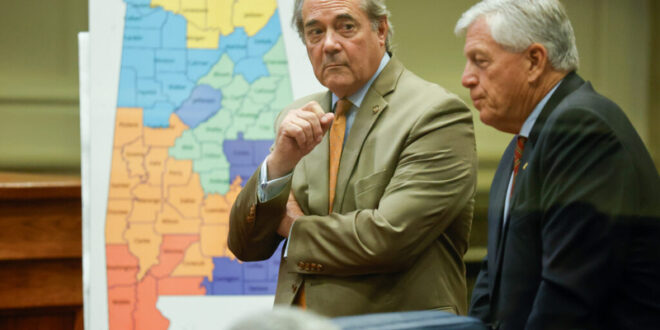
The battle over Alabama’s congressional district lines will go to federal court Friday, before the judges who ruled a 2023 map unconstitutional but after the U.S. Supreme Court’s decision in Louisiana v. Callais weakening the Voting Rights Act.
The three-judge panel will consider a request from plaintiffs in Allen v. Milligan, the case challenging the congressional maps, and two other related cases. If granted, the preliminary injunction would prevent the state from reverting to the old map and holding special primaries in August in the 1st, 2nd, 6th and 7th congressional districts under the 2023 map. It would also certify the primary election results on Tuesday, which took place under the current court-ordered map.
Alabama, however, said the remedial maps are invalid because they do not meet the interests of the state.
“Yet it is undisputed that Plaintiffs’ illustrative maps and the Court’s remedial map ‘do not achieve all the political goals of the Legislature, particularly the goal of keeping Mobile and Baldwin Counties whole and together in one congressional district,’” said the Alabama Secretary of State’s motion to oppose the preliminary injunction.
Louisiana v. Callais made it harder for plaintiffs to challenge legislative maps as racially discriminatory. Writing for the 6-3 majority, Justice Samuel Alito said plaintiffs doing so must prove intent to discriminate, a significantly higher standard than the previous one. But Marina Jenkins, executive director of the National Democratic Redistricting Committee, which supports the Milligan plaintiffs, said on a press call Thursday they believed they could reach it.
“Callais narrowed Section 2, but it did not kill it,” she said Marina Jenkins. “This case clears every bar Callais set.”
The motion for a preliminary injunction alleges that Alabama is violating its own constitution by enacting a law related to elections less than six months before an election. Plaintiffs also cited prior decisions by courts to prevent changing election laws or procedures close to an election, noting Alabama set the special primary as absentee voters cast ballots in Tuesday’s primary.
Plaintiffs also said their case holds despite the Callais decision. Alito wrote that a majority-minority district created by Louisiana amounted to an unconstitutional racial gerrymandered district in violation of the equal protection clause of the 14th Amendment. Attorneys for the plaintiffs argue that is not the case in Milligan.
“Plaintiffs’ maps were drawn without relying on race, and the special master drew the remedial plan race-blind without any particular difficulty,” Jenkins said.
The remedial map also meets the state’s political interests, plaintiffs argue, because it was drawn using the criteria that the Legislature had followed when it created the 2023 maps during the special session.
“Alabama’s own legislators disclaimed any partisan intent when drawing the 2023 map,” Jenkins said. “Alabama cannot now retroactively manufacture a partisan justification it did not assert when the 2023 map was drawn.”
Jenkins also argued that the 2023 map created by the Legislature intentionally discriminated against minority voters based on the court’s own ruling after the Legislature created a map in the 2023 special session.
The Callais decision led to a wave of redistricting efforts by GOP-controlled southern states to increase Republican representation in Congress. Gov. Kay Ivey convened a special session of the Alabama Legislature earlier this month where Republican lawmakers passed two bills that authorized special primaries for congressional and state Senate districts. A challenge to the state Senate map is still pending.
by Ralph Chapoco, Alabama Reflector
Alabama Reflector is part of States Newsroom, a nonprofit news network supported by grants and a coalition of donors as a 501c(3) public charity. Alabama Reflector maintains editorial independence. Contact Editor Brian Lyman for questions: [email protected].