Poli Alert Politics & Civics
Related Articles


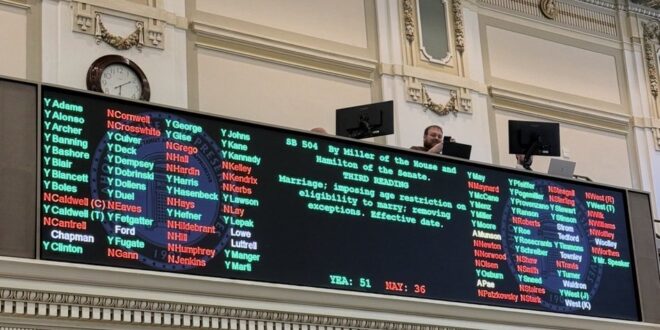
Dozens of Republican lawmakers in Oklahoma voted against legislation banning child marriage this week, nearly derailing a bill that ultimately made the state the 17th in the nation to prohibit marriage under the age of 18 without exceptions.
Senate Bill 504 became law Tuesday without the signature of Gov. Kevin Stitt after narrowly passing the Oklahoma House in a 51-36 vote. All 36 votes opposing the bill came from Republican lawmakers.
The legislation establishes 18 as the minimum legal age for marriage in Oklahoma and eliminates previous exceptions that allowed minors to marry with parental consent or court approval.
The law takes effect Nov. 1 and does not affect marriages performed before that date.
Before the bill’s passage, Oklahoma was among only four states without a true statutory minimum age for marriage once all legal exceptions were considered.
Under prior law, 16- and 17-year-olds could marry with permission from a parent or guardian, while children younger than 16 could obtain court approval to marry in cases involving pregnancy.
Supporters of the legislation argued those loopholes left minors vulnerable to coercion and abuse.
“This is about protecting children,” said state Sen. Warren Hamilton, the Republican who introduced the bill. Hamilton said minors remain vulnerable to exploitation and need stronger legal safeguards.
The bill passed unanimously in the state Senate earlier this year before facing fierce resistance in the House.
Republican opposition dominates House debate
The House floor debate became one of the most contentious social policy battles of Oklahoma’s legislative session, with several Republican lawmakers arguing the government should not interfere in family decisions involving marriage.
State Rep. Jim Olsen questioned whether the state should completely prohibit marriage involving 17-year-olds under any circumstances.
“How confident is your view that it is always wrong, 100% of the time for 17-year-olds to get married,” Olsen asked House sponsor Nicole Miller during debate.
Miller responded: “How confident are you that it’s always right.”
Other Republicans argued the law unnecessarily restricted parental rights and religious principles surrounding marriage.
State Rep. Danny Williams defended maintaining exceptions for young couples facing unexpected pregnancies.
“The ones who want to put it together and try and are in a circumstance and are less than the age of 18 ought to have the right to do that,” Williams said during debate. “Marriage was set up by God, not the State of Oklahoma.”
State Rep. Jim Shaw publicly defended his vote against the bill on social media, citing concerns about parental rights.
Advocates against child marriage hailed the measure as a major victory after years of lobbying in Oklahoma and other states.
According to research compiled by Unchained At Last, Oklahoma ranked fifth nationally for child marriage rates before the law’s passage.
The organization estimates more than 314,000 minors were married nationwide between 2000 and 2021, with girls accounting for the overwhelming majority of cases.
Supporters of child marriage bans argue minors often lack the legal and financial ability to leave abusive relationships or fully consent to marriage arrangements.
Opponents of blanket bans, however, have argued that some teenagers should retain the option to marry under limited circumstances, particularly involving pregnancy or long-term relationships.
Governor stays on sidelines
Stitt did not publicly endorse or oppose the bill and allowed it to become law without his signature.
Under Oklahoma law, legislation automatically becomes law if the governor neither signs nor vetoes it within a designated timeframe.
The governor’s silence reflected broader divisions within the state Republican Party over how far the government should go in regulating family and social issues.
Broader context
The legislation follows another Oklahoma law passed in 2025 raising the state’s age of sexual consent from 16 to 18.
Supporters said the changes close long-standing legal inconsistencies that previously allowed minors to marry despite lacking other adult legal rights, including voting, serving on juries or signing binding contracts.
Oklahoma now joins states including Delaware, New Jersey and Virginia in banning child marriage outright.
Still, 33 states continue allowing some form of child marriage under legal exceptions.
The law will officially take effect Nov. 1, ending all legal pathways for minors to marry in Oklahoma.
Advocacy organizations are expected to continue pushing for similar legislation in states that still permit underage marriage through parental or judicial exceptions.