Poli Alert Politics & Civics
Related Articles


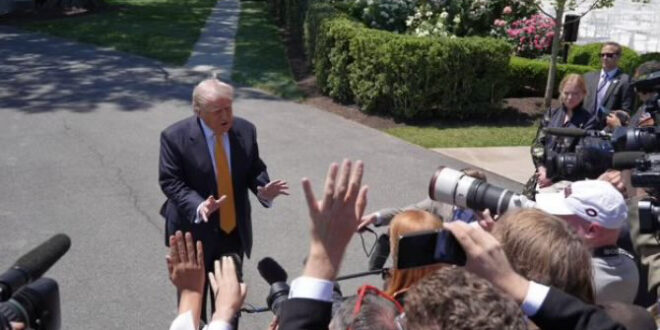
President Donald Trump said Tuesday that Americans’ financial struggles are not influencing his negotiations with Iran, drawing immediate backlash as inflation and fuel prices continue climbing during the ongoing war.
Speaking to reporters on the White House South Lawn before departing for a diplomatic trip to China, Trump was asked to what extent rising costs for American families were motivating him to pursue a deal with Iran.
“Not even a little bit,” Trump replied. “The only thing that matters when I’m talking about Iran — they can’t have a nuclear weapon. I don’t think about Americans’ financial situation. I don’t think about anybody. I think about one thing — we cannot let Iran have a nuclear weapon. That’s all.”
Trump: “Americans’ financial situation — I don’t think about anybody. I think about one thing. We cannot let Iran have a nuclear weapon. That’s all.” pic.twitter.com/wPNjVeQkew
— Aaron Rupar (@atrupar) May 12, 2026
When reporters pressed him on whether he was considering the economic fallout from the war, Trump doubled down.
“The most important thing by far — including whether our stock market, which, by the way, is at an all-time high — but including whether our stock market goes up or down a little bit, the most important thing by far is Iran cannot have a nuclear weapon,” Trump said. “Every American understands.”
Inflation and gas prices rise during conflict
Trump’s remarks came as new economic data showed inflation accelerating amid continued instability in the Middle East.
The conflict began in late February after joint U.S. and Israeli strikes on Iranian targets. Since then, Iran has restricted access through the Strait of Hormuz, a critical global shipping lane that typically carries about one-fifth of the world’s oil supply.
The disruption has sent energy prices sharply higher. AAA data Tuesday showed the national average price for regular gasoline reached $4.50 per gallon, while diesel climbed above $5.60.
At the same time, the Bureau of Labor Statistics reported that consumer prices rose 3.8% in April compared with a year earlier, the highest inflation rate since 2023. The agency said energy costs accounted for more than 40% of the monthly increase in overall prices.
Economists have warned that prolonged instability around the Strait of Hormuz could continue driving up fuel, shipping and consumer costs globally.
Democrats and administration critics quickly seized on Trump’s comments, arguing they reinforced voter concerns about affordability and the economy.
Leah Leszczynski, a spokesperson for Democrats in Michigan, said the remarks showed Trump was disconnected from the financial struggles many Americans are facing.
“While families are struggling to pay for necessities, Trump is saying the quiet part out loud — and it’s equivalent to ‘let them eat cake,’” she said.
Online reaction was also swift, with clips of Trump’s remarks spreading widely across social media and prompting criticism from opponents who accused the president of dismissing the economic burden facing working families.
While job growth has remained stronger than expected and stock indexes have continued hitting record highs, polling suggests Americans remain deeply dissatisfied with economic conditions.
A CNN/SSRS survey conducted between April 30 and May 4 found that 70% of Americans disapproved of Trump’s handling of the economy, the highest level recorded by the pollster across both of Trump’s terms.
An NBC News Decision Desk Poll released last month similarly found that roughly two-thirds of respondents disapproved of Trump’s handling of inflation and the Iran conflict.
Trump has argued that preventing Iran from obtaining nuclear weapons outweighs short-term economic consequences. On Sunday, he rejected Iran’s latest proposal aimed at ending the conflict, calling it “unacceptable,” and warned Monday that an existing ceasefire was “on life support.”
The president’s comments highlight the growing political tension between Trump’s aggressive foreign policy posture toward Iran and mounting economic anxiety at home.
Historically, oil market disruptions tied to conflict in the Persian Gulf have had major ripple effects throughout the global economy. Analysts say the current crisis is reviving fears of sustained inflation just as many Americans were beginning to recover from years of elevated prices.
Republicans have largely defended Trump’s approach, arguing that national security concerns must take priority over temporary economic disruptions. Critics, however, contend the administration has underestimated the financial impact the war is having on households already strained by rising costs.
Trump is expected to discuss Iran and global energy markets during meetings with Chinese officials this week, though the White House has not announced any new peace framework or diplomatic breakthrough.
Meanwhile, economists and political strategists are closely watching whether rising fuel prices and inflation become a larger liability for the administration heading into the 2026 midterm election cycle.