


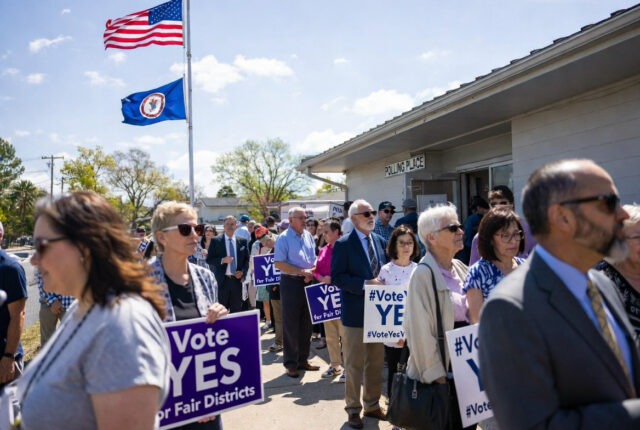
Virginia voters are headed to the polls Tuesday to decide whether to approve an unusual mid-decade redrawing of congressional districts, a move that could boost Democrats’ chances of flipping control of the U.S. House and intensify a growing national redistricting battle.
The proposed constitutional amendment, backed by Democratic leaders, would allow the state to bypass its bipartisan redistricting commission and implement a new congressional map approved by lawmakers earlier this year.
The vote represents a major political test in a closely divided House landscape — and a referendum on whether voters are willing to accept partisan-driven redistricting after previously supporting reforms to limit it.
Redistricting typically occurs once every decade following the U.S. census. But the process has increasingly become a political tool, with both parties seeking to redraw maps ahead of elections to gain an advantage.
The current push follows efforts by Donald Trump, who urged Republican-led states such as Texas to redraw districts ahead of the 2026 midterms. That move helped spark a broader wave of redistricting efforts nationwide.
Virginia now joins California as one of the few states to pursue a mid-decade redraw through a public vote.
At issue is whether lawmakers should be allowed to circumvent the state’s bipartisan redistricting commission — a system approved by voters in 2020 to reduce partisan gerrymandering.
Supporters argue the amendment is a necessary response to Republican-led redistricting efforts in other states. Opponents say it undermines voter-approved reforms and reintroduces partisan map-drawing.
The outcome may not be final. The Supreme Court of Virginia is currently weighing whether the redistricting process violated state law, after a lower court ruled the effort illegal on procedural grounds.
If the court upholds that decision, the referendum results could be nullified.
Democratic Gov. Abigail Spanberger has defended the effort as a countermeasure to Republican gains elsewhere, arguing it would help “push back” against what she described as partisan manipulation of congressional maps.
House Minority Leader Hakeem Jeffries said approval of the measure would act as a “check and balance” on the Trump administration.
Trump, meanwhile, urged voters to reject the amendment, writing on social media that Virginians should “vote ‘no’ to save your country.”
Former Virginia Gov. Glenn Youngkin criticized the plan as “dishonest” and “brazenly deceptive” during a campaign event Monday.
The proposal has drawn sharp criticism from Republican leaders, including Virginia GOP Chairman Jeff Ryer, who accused Democrats of reversing their long-standing opposition to gerrymandering.
Democrats have countered that the political landscape has changed, pointing to aggressive redistricting efforts in Republican-controlled states.
The debate has also featured national figures, with ads supporting the measure highlighting former President Barack Obama.
Broader Context
The Virginia vote is part of a broader escalation in redistricting battles across the country ahead of the 2026 midterm elections.
Republicans believe new maps in states like Texas, Missouri, North Carolina and Ohio could net them up to nine additional House seats. Democrats are aiming to counter those gains with new maps in California, Utah and potentially Virginia.
Currently, Democrats hold six of Virginia’s 11 U.S. House seats under maps imposed by the state Supreme Court in 2021. The proposed redraw could increase that number significantly, potentially reshaping the balance of power in Congress.
One proposed district — described by critics as “lobster-shaped” — stretches from Democratic-leaning Northern Virginia into more conservative rural areas, illustrating the extent of the changes.
If approved, the new districts would take effect for upcoming congressional elections, though ongoing legal challenges could delay or block implementation.
Meanwhile, the redistricting battle is expected to continue elsewhere. Florida lawmakers are set to convene for a special session later this month that could produce new maps favoring Republicans.
With control of the House hanging in the balance, the outcome of Virginia’s vote — and the court’s pending decision — could play a pivotal role in shaping the 2026 election landscape.
