

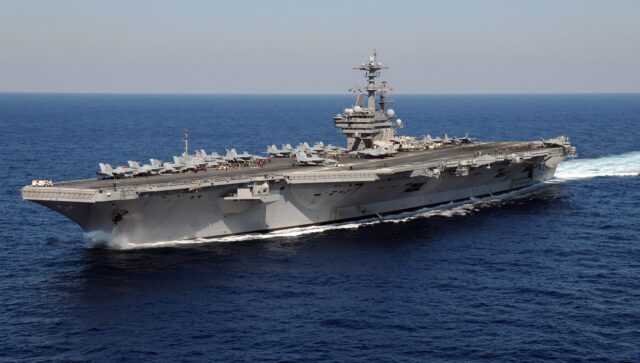
The Pentagon is deploying thousands of additional U.S. troops to the Middle East in the coming days, expanding its military presence as Donald Trump intensifies pressure on Iran to reach a nuclear agreement while preparing for possible escalation if a fragile ceasefire collapses.
The deployment includes roughly 6,000 personnel aboard the USS George H.W. Bush and its accompanying warships, along with about 4,200 troops assigned to the Boxer Amphibious Ready Group and the 11th Marine Expeditionary Unit, according to U.S. officials who spoke on the condition of anonymity to discuss military movements.
The additional forces are expected to arrive as a two-week ceasefire between U.S.-aligned forces and Iran nears expiration on April 22, joining an estimated 50,000 U.S. personnel already operating in the region.
The buildup coincides with a sweeping U.S. maritime blockade targeting Iranian ports and shipping routes, part of a broader effort by the Trump administration to pressure Tehran economically and diplomatically. The strategy aims to force Iran to reopen the Strait of Hormuz — a critical artery for global oil shipments — and abandon its nuclear program.
Trump said over the weekend that negotiations led by JD Vance could resume soon, despite faltering talks. He also expressed optimism that the conflict could end quickly, suggesting energy prices would fall if a deal is reached preventing Iran from obtaining nuclear weapons.
Iranian officials, however, have responded with threats to disrupt international trade. Maj. Gen. Ali Abdollahi warned that Iran could block imports and exports across key waterways, including the Persian Gulf, Gulf of Oman and Red Sea, in retaliation for the U.S. blockade.
The expanding U.S. military presence will soon include three aircraft carriers in or near the region — the USS Abraham Lincoln, the USS Gerald R. Ford and the George H.W. Bush — providing commanders with a wide range of operational options.
Military analysts say the buildup is designed to increase leverage in negotiations while ensuring readiness for potential conflict. James Foggo said the additional forces provide “reserve capacity” if the situation deteriorates, allowing for a broader range of military responses.
White House press secretary Karoline Leavitt said Trump “has wisely kept all options on the table” if Iran refuses to meet U.S. demands, predicting that economic pressure from the blockade would increase Tehran’s urgency to strike a deal.
U.S. Central Command and the Pentagon declined to comment on specific operational details, but officials said naval forces are actively intercepting vessels suspected of supporting Iran. In the first 24 hours of enforcement, six merchant ships were stopped and returned to Iranian ports without incident.
The blockade is being enforced by more than a dozen U.S. warships positioned near the Strait of Hormuz, with specialized boarding teams from Navy, Marine and Coast Guard units prepared to seize vessels if necessary. Such operations carry significant risk, as crews could resist or Iranian forces could respond with drones or fast-attack boats.
Trump acknowledged those risks in a social media post, warning that any vessels approaching U.S. forces could be “immediately eliminated,” referencing aggressive maritime enforcement tactics used in other regions.
Officials say the administration is also weighing more direct military options if diplomacy fails. Potential scenarios under discussion include Special Operations missions targeting nuclear materials, deploying Marines to secure strategic المواقع, or seizing critical infrastructure such as Kharg Island, a key Iranian oil export hub.
Experts caution that such operations would carry far greater risks than maintaining a naval blockade. Mick Mulroy said any ground deployment in Iran would likely result in casualties and significant escalation.
“It’s not going to be without consequences,” Mulroy said. “There will likely be casualties.”
Even the blockade itself presents challenges. While it could significantly strain Iran’s economy, analysts note it may also contribute to rising global energy prices, creating political and economic pressure at home.
As the ceasefire deadline approaches and negotiations remain uncertain, the growing U.S. military presence underscores the high stakes facing both Washington and Tehran in the days ahead.