Poli Alert Politics & Civics
Related Articles



The House on Tuesday overwhelmingly approved a sweeping aviation safety bill in response to a deadly 2025 midair collision near Ronald Reagan Washington National Airport, though the measure drew criticism from senators and victims’ families who say it falls short of preventing future disasters.
In a 396-10 vote, lawmakers passed the ALERT Act, legislation aimed at strengthening aircraft safety requirements months after the chamber rejected a separate Senate-backed proposal that had unanimous support.
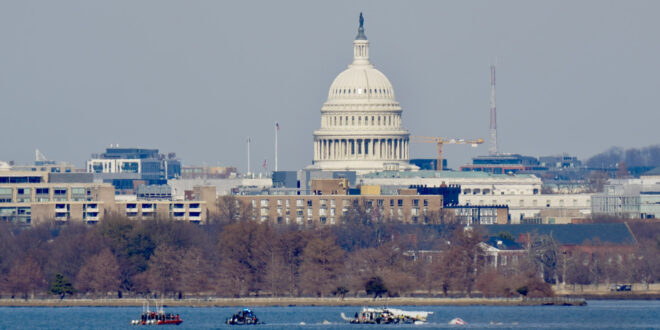
The bill follows the January 2025 collision between an American Airlines passenger jet and a U.S. Army Black Hawk helicopter that killed all 67 people aboard both aircraft, one of the deadliest aviation incidents in recent years.
The ALERT Act would require most aircraft operating near busy airports — including military planes — to install technology capable of receiving real-time location data from nearby aircraft. While many planes already use a system known as ADS-B Out to broadcast their position, the bill focuses on expanding the use of ADS-B In, a complementary system designed to help pilots detect and avoid potential collisions.
According to the National Transportation Safety Board, the presence of ADS-B In technology on American Airlines Flight 5342 could have prevented the fatal crash. The legislation also mandates that military aircraft install collision-prevention systems by 2031, though it includes exemptions for certain platforms such as fighters, bombers and drones.
House Republican leaders fast-tracked the bill under a procedure requiring a two-thirds majority for passage. The move came after the Senate’s version, known as the ROTOR Act, failed in February by a single vote following a reversal from the U.S. Department of Defense.
The Pentagon had initially supported the Senate bill but later warned it could create “significant unresolved budgetary burdens and operational security risks,” raising concerns about its impact on national defense operations.
In addition to technology requirements, the House bill addresses helicopter route safety and airspace separation standards — factors the NTSB identified as the probable cause of the 2025 collision. It also includes provisions to improve air traffic control training and operational procedures.
Lawmakers amended the legislation after the NTSB said earlier this year that the original proposal did not fully address its 50 safety recommendations. The agency later said the revised bill would require federal agencies, including the Department of Transportation and the Federal Aviation Administration, to take steps that would ultimately meet its guidance.
Despite those changes, victims’ families expressed concern that the legislation does not go far enough. In a statement Tuesday, they warned that the collision-avoidance technologies outlined in the bill are not yet widely available and could take years to implement, potentially leading to delays and waiver requests from the aviation industry.
Criticism also came from Senate leaders. Ted Cruz and Maria Cantwell, who lead the Senate Commerce Committee, previously said the ALERT Act lacks clear requirements to ensure timely adoption of ADS-B technology.
Cruz reiterated his concerns Tuesday, arguing the Senate’s ROTOR Act remains the stronger proposal. “Congress should not advance a bill that neither improves aviation safety nor closes the loopholes that have allowed operators, including the military, to fly blind in congested airspace,” he said.
The House-passed bill now heads to the Senate, where its fate remains uncertain given earlier opposition and ongoing disagreements over how best to implement new safety standards.