Poli Alert Politics & Civics
Related Articles

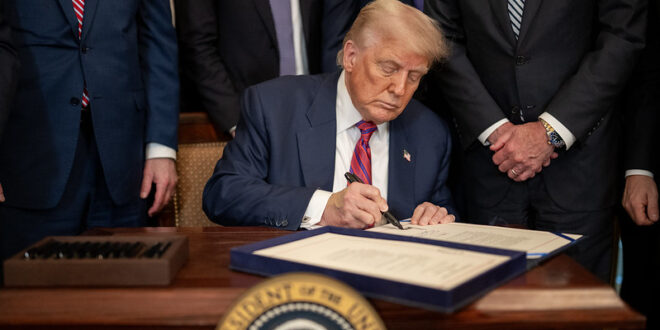
Donald Trump signed a sweeping executive order Tuesday aimed at reshaping how mail ballots are distributed and verified, setting up a likely legal showdown over federal authority in U.S. elections.
The order directs federal agencies to help create citizenship-based voter lists and calls on the United States Postal Service to deliver ballots only to individuals appearing on those lists — a move election experts say could conflict with the Constitution’s delegation of election authority to the states.
What the order does
The directive instructs the Department of Homeland Security to compile “state citizenship lists” using federal databases, including naturalization records and Social Security Administration data.
Those lists would then be shared with states to verify voter rolls.
Under the order, the Postal Service would be asked to transmit mail ballots only to individuals confirmed on those lists — raising logistical and legal questions about how the agency would implement such a mandate.
Constitutional questions emerge
The order is expected to face immediate court challenges.
Under the United States Constitution, states have primary authority to administer elections, including rules governing voter registration and mail voting. Congress retains some regulatory power, but the president’s role is limited.
Legal experts say the order could be struck down for overstepping executive authority.
David Becker, founder of the Center for Election Innovation & Research, said the measure is unlikely to survive judicial review.
“The Constitution clearly gives the power to regulate these issues related to mail ballots to the states,” Becker said. “The president has been excluded by the framers from dictating election policy to the states.”
Ties to past election disputes
The effort reflects Trump’s longstanding focus on election procedures following his loss in 2020, which he continues to falsely claim was fraudulent.
Two figures involved in efforts to challenge the 2020 results — Kurt Olsen and Heather Honey — were part of discussions surrounding the new order, according to a person familiar with the matter.
Olsen now serves in a White House role focused on election security, while Honey holds a senior position at DHS.
Broader push to reshape voting rules
The executive order is Trump’s second major action on elections since returning to office.
A prior order sought to impose proof-of-citizenship requirements for voter registration and penalize states that allow extended deadlines for mail ballots. Courts blocked key portions of that directive.
Trump has also backed legislation such as the SAVE America Act, which would require documentary proof of citizenship and stricter voter identification standards nationwide.
The bill passed the House but remains stalled in the Senate, where it faces a 60-vote threshold.
Political and practical implications
The new order could significantly affect how mail voting operates if implemented, particularly in states that rely heavily on absentee ballots.
It also raises operational concerns for the Postal Service, which has faced funding challenges and would be tasked with enforcing new eligibility requirements tied to federal data systems.
Trump framed the move as an effort to strengthen election integrity.
“We’d like to have voter ID. We’d like to have proof of citizenship,” he said while signing the order, adding that he believes courts will uphold the action.
Legal challenges are expected to be filed quickly, with courts likely to weigh whether the order violates constitutional limits on presidential power.
The outcome could shape not only the future of mail voting, but also the broader balance of authority between federal and state governments in administering U.S. elections.