

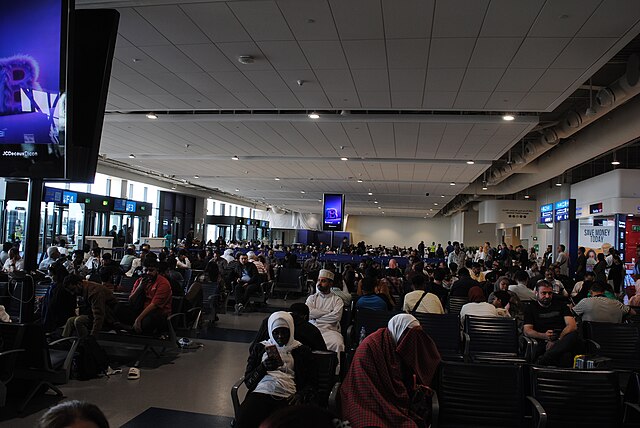
Thousands of Americans are stranded across the Middle East after the United States and Israel launched airstrikes against Iran, triggering retaliatory drone attacks and widespread airspace closures that have complicated evacuation efforts for civilians.
In the days following the strikes, the United States Department of State issued new travel advisories urging Americans to reconsider travel to several countries in the region. But critics say those warnings came too late, leaving many U.S. citizens trapped as airports shut down and embassies scrambled to respond to escalating violence.
Democratic lawmakers and current and former diplomats are sharply criticizing the Donald Trump administration for what they describe as a failure to anticipate the predictable consequences of military escalation with Iran.
“These issues were predictable,” dozens of lawmakers wrote in a letter to Marco Rubio, the secretary of state. “The lack of clear preparation, planning, and communication to Americans abroad is unacceptable and a violation of the State Department’s basic mission to provide consular assistance and the protection of U.S. citizens overseas.”
Confusion for Americans overseas
U.S. citizens in countries including Jordan, Kuwait, and the United Arab Emirates reported receiving conflicting guidance from the State Department.
In some cases, Americans were advised to evacuate immediately even though airports had already closed because of Iranian drone attacks. Others were instructed to contact U.S. embassies for help but encountered busy phone lines or overwhelmed consular staff unable to provide immediate assistance.
“It happened all very quickly,” Trump told reporters Tuesday when asked why the government had not better prepared for the fallout from the strikes.
The rapidly deteriorating security situation has forced several diplomatic facilities to respond to direct threats. The United States Embassy in Jordan was evacuated because of the risk of attack, while the United States Embassy in Kuwait was struck by a drone. Two Iranian drones also hit the United States Embassy in Saudi Arabia, sparking a fire, and another attack ignited a blaze in a parking lot outside the United States Consulate in Dubai.
At least six American service members have been killed since the U.S.-Israeli campaign began, though there have been no confirmed civilian casualties among Americans abroad.
Administration defends response
The White House pushed back on criticism that the government failed to adequately warn Americans.
Press secretary Karoline Leavitt said the State Department had issued multiple warnings before the conflict escalated.
“There were many signs put out by the State Department,” Leavitt said Wednesday, noting that several countries in the region already carried Level 4 “Do Not Travel” warnings dating back to January.
Those warnings applied to countries such as Iran, Iraq, Lebanon, Syria and Yemen.
However, it was only after the military campaign began that the State Department issued Level 3 “Reconsider Travel” advisories for additional countries, including Jordan, Kuwait, Oman, Qatar, Saudi Arabia, the United Arab Emirates and Cyprus.
Evacuation efforts underway
Rubio said the U.S. government has begun organizing charter flights to evacuate Americans but warned that airspace closures caused by Iranian drone attacks have made operations difficult.
“The challenge we are facing is airspace closures,” Rubio told reporters. “But rest assured, we are confident that we are going to be able to assist every American.”
The United States Department of Defense said the military is also preparing to support evacuation efforts using Boeing C-17 Globemaster III cargo aircraft.
By Wednesday, the State Department said it had assisted roughly 6,500 Americans overseas with security guidance and travel assistance, and officials confirmed that at least one evacuation flight had already departed the region.
Diplomatic staffing concerns
Current and former diplomats say the crisis has exposed deeper structural issues within the State Department.
They point to workforce reductions during the Trump administration and the absence of confirmed U.S. ambassadors in several Middle Eastern countries as factors that may have weakened the government’s ability to respond quickly.
The American Foreign Service Association, the union representing U.S. diplomats, warned that recent staffing cuts have eroded the department’s crisis-response capacity.
The group said the loss of experienced personnel — including specialists with Farsi and Arabic expertise — has created “real gaps in America’s diplomatic readiness.”
“When you don’t have the professionals that you would normally see, you don’t have confirmed ambassadors in post,” a former senior State Department official said. “That’s really impacting both our planning and our messaging.”