Poli Alert Politics & Civics
Related Articles


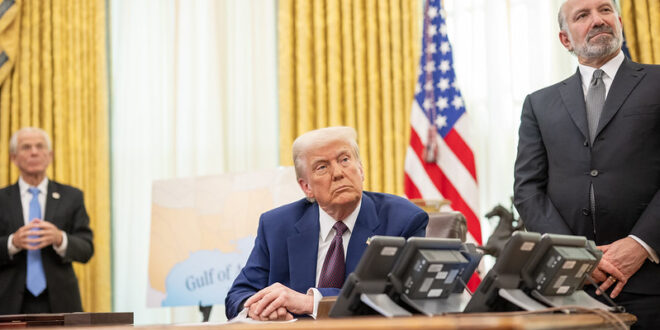
President Donald Trump signed a proclamation Friday night imposing a new 10% tariff on most foreign imports to the United States, moving swiftly to revive his trade agenda just hours after the U.S. Supreme Court struck down an earlier set of sweeping tariffs.
The new tariffs will take effect Monday and remain in place for 150 days, according to a White House fact sheet. Unlike the tariffs invalidated by the court, the new duties rely on a separate legal authority and are designed to survive judicial scrutiny.
“It is my Great Honor to have just signed, from the Oval Office, a Global 10% Tariff on all Countries, which will be effective almost immediately,” Trump wrote in a post on Truth Social.
How these tariffs differ from the ones the court struck down
Earlier Friday, the Supreme Court ruled that Trump exceeded his authority by imposing tariffs under the International Emergency Economic Powers Act, or IEEPA, a 1977 law that had never before been used to levy import duties.
In response, Trump turned to Section 122 of the Trade Act of 1974, which allows the president to impose tariffs of up to 15% for as long as 150 days to address “large and serious” balance-of-payments deficits.
Unlike IEEPA, Section 122 explicitly authorizes temporary tariffs, giving the administration a stronger legal footing — at least in the short term.
What imports are affected — and what’s exempt
Under the new proclamation, the 10% tariff applies to most foreign imports, but several categories are exempt, including:
-
Certain food products
-
Critical minerals
-
Electronics
-
Automobiles
Goods from Canada and Mexico that fall under the United States–Mexico–Canada Agreement are also excluded.
The administration said the exemptions are intended to limit supply-chain disruptions while maintaining pressure on trading partners.
Reviving Trump’s tariff strategy
The move marks Trump’s latest effort to resurrect a worldwide tariff regime that is central to his economic platform. Trump argues that broad tariffs are necessary to shrink trade deficits, protect U.S. industry and bring manufacturing jobs back to the United States.
Economists, however, have repeatedly warned that tariffs largely raise prices for consumers and businesses rather than foreign exporters.
The new 10% tariff closely mirrors the baseline rate Trump imposed last year on goods from dozens of countries. Many nations previously faced higher “reciprocal” tariffs or additional levies tied to drug-trafficking concerns involving China, Canada and Mexico, though some of those rates were later reduced through negotiations.
Those earlier measures depended on the administration’s now-rejected interpretation of IEEPA.
What happens to Trump’s trade deals
It remains unclear whether the administration will attempt to reinstate higher tariff rates that were invalidated by the court.
Asked Friday whether his existing trade deals still apply, Trump told reporters: “Some of them stand. Many of them stand. Some of them won’t, and they’ll be replaced with the other tariffs.”
In addition to the new tariffs, Trump directed U.S. Trade Representative Jamieson Greer‘s office to open new investigations under Section 301 of the Trade Act, which allows the United States to impose tariffs or other penalties in response to unfair or discriminatory trade practices.
Those investigations could lead to additional duties beyond the 150-day window covered by the new proclamation.
Broader implications
The rapid pivot highlights both Trump’s determination to maintain tariffs as a core economic tool and the legal limits imposed by the courts. While Section 122 offers a temporary workaround, longer-term tariffs would likely require congressional approval or reliance on other trade statutes — each with its own legal and political risks.
For now, businesses face renewed uncertainty as another round of tariffs takes effect just days after the Supreme Court sharply curtailed presidential power over trade.