Poli Alert Politics & Civics
Related Articles


The Trump administration appears poised to launch an extended military assault on Iran, current and former U.S. officials said, as the Pentagon assembles a massive strike force in the Middle East despite the risk of U.S. combat fatalities and the possibility of becoming entangled in a prolonged regional war.
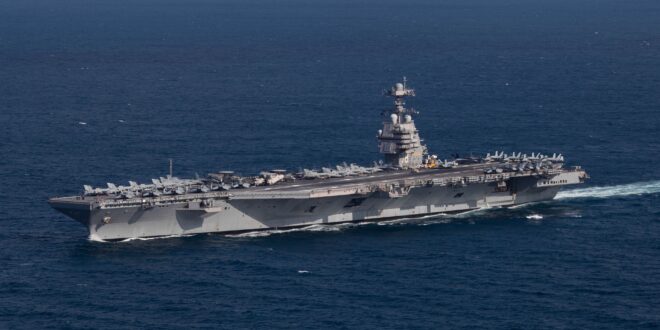
The arsenal, built up over several weeks, is awaiting the arrival of the aircraft carrier USS Gerald R. Ford and its accompanying warships, officials familiar with the planning said. Military leaders last week extended the carrier’s deployment and ordered the strike group to the region from the Caribbean Sea.
The vessels were approaching the Strait of Gibraltar on Thursday, making military action possible within days, according to the officials, who spoke on the condition of anonymity to discuss sensitive planning.
President Donald Trump offered mixed signals Thursday morning when asked about Iran.
“Maybe we’re going to make a deal. Maybe not,” Trump said at the inaugural meeting of his newly formed Board of Peace. “You’re going to be finding out over the next, maybe, 10 days.” Later in the day, he narrowed the timeline to “10 to 15 days, pretty much, maximum.”
Military preparations accelerate
Trump’s top national security advisers met Wednesday in the Situation Room to review the Iran posture. U.S. forces deployed to the region are expected to be fully in place by mid-March, according to a U.S. official familiar with the matter.
Administration officials said the White House wants it clearly understood that it is building combat power in the region. Trump has publicly floated the possibility of regime change, suggesting last week that removing Iran’s supreme leader, Ayatollah Ali Khamenei, “would be the best thing that could happen” if Tehran ends up with new leadership.
Still, it remains unclear whether Trump has formally approved military action. Some officials noted that the ongoing Winter Olympics, which conclude Sunday in Italy, remain one consideration in the timing of any strike.
Risks of escalation
The United States, backed by ally Israel, would have an overwhelming military advantage over Iran, said Daniel B. Shapiro, a former senior Pentagon official in the Biden administration. The Ford strike group would join a formidable array of U.S. assets already positioned in or near the Middle East, including dozens of fighter jets, advanced air-defense systems and naval destroyers.
But Shapiro warned that a conflict with Iran carries significant risks.
Iran possesses ballistic missiles capable of killing U.S. troops, a web of proxy forces across the Middle East that could rapidly expand the conflict, and the ability to disrupt maritime shipping and global energy markets.
“They’ll definitely take terrible damage from combined U.S.-Israeli strikes,” said Shapiro, now a distinguished fellow at the Atlantic Council. “But that doesn’t mean it ends quickly, or clean — and they do have some ability to impose some costs in the other direction.”
Troop movements underway
Some U.S. troops are expected to be withdrawn from bases in the Middle East if the Pentagon proceeds with final preparations for combat, two people familiar with the matter said. Others will remain to defend installations from possible attacks, while additional personnel could be relocated to Europe or the United States, one official said.
The Pentagon has taken similar precautionary measures ahead of past conflicts in the region.
Diplomacy collides with force buildup
The military surge comes as U.S. and Iranian officials continue talks aimed at modifying Tehran’s nuclear program. White House press secretary Karoline Leavitt said this week the negotiations had produced “a little bit of progress,” but added the sides remain “very far apart.”
Iranian officials are expected to return with additional proposals “in the next couple of weeks,” Leavitt said — though it remains unclear whether Trump is willing to wait that long.
European diplomats initially believed the U.S. buildup was designed primarily to extract concessions at the negotiating table. But after talks concluded Tuesday in Geneva, officials now believe Tehran is unwilling to compromise on what it considers core positions, including its right to enrich uranium.
“The Iranians were planning to drown them in technicalities and delay substance,” said a European diplomat briefed on the talks. “While a more traditional approach would have built on the dialogue, … Trump does not have the patience.”
Regional fears of wider war
Officials in Saudi Arabia and the United Arab Emirates initially viewed the U.S. military posture as stabilizing, the diplomat said, but signs that Washington is preparing for an extended conflict have raised alarm.
“Some actors may have favored targeted strikes to add pressure on Iran,” the diplomat said. “But an extended conflict will be bloody and it could bring more countries, either deliberately or by miscalculation, into the war.”
Israel presses its case
Secretary of State Marco Rubio plans to travel to Israel on Feb. 28 to meet with Prime Minister Benjamin Netanyahu, a State Department official said. The visit is intended to brief Netanyahu on the status of U.S.-Iran talks, though it does not preclude military action beforehand.
Netanyahu has openly urged Washington to strike Iran and outlined sweeping demands for any diplomatic deal, including a ban on uranium enrichment, dismantling nuclear infrastructure, removal of all enriched uranium from Iran and strict limits on Tehran’s ballistic missile program.
Middle East analysts say Iran is unlikely to accept those terms, viewing them as an existential threat to its national security.
Iran pushes back
Khamenei has resisted signing any agreement, arguing Iran has the right to civilian nuclear power and an unrestricted missile arsenal. In recent social media posts, he taunted U.S. officials over the military buildup.
“The Americans constantly say that they’ve sent a warship toward Iran,” he wrote Tuesday. “Of course, a warship is a dangerous piece of military hardware. However, more dangerous than that warship is the weapon that can send that warship to the bottom of the sea.”
A potential turning point
An extended assault on Iran would mark the most consequential U.S. military action against the country in decades. Iran has long sponsored attacks on U.S. forces through proxy militias across the region.
Trump began weighing new strikes in January after pledging to support anti-government protesters in Iran following a wave of executions. He initially shelved military plans after defense officials warned that Iran’s response could overwhelm the relatively small U.S. footprint in the region at the time.
Since then, the Pentagon has surged assets, including another aircraft carrier, USS Abraham Lincoln, diverted from the South China Sea. Advanced F-35 fighter jets, refueling tankers and air-defense systems have also repositioned across Europe and the Middle East.
The buildup signals preparation for something “much more extended than a one-day cycle” of strikes, said Dana Stroul, now with the Washington Institute.
Warning signs
An extended war would represent a sharp departure from Trump’s previous military actions, which were significant in scope but limited in duration. Those included last year’s strikes on Iranian nuclear facilities, a bombing campaign against Houthi forces in Yemen, and a January raid targeting Venezuelan President Nicolás Maduro.
Trump has repeatedly criticized prior U.S. administrations for becoming trapped in long Middle East wars. But the absence of catastrophe in recent operations may obscure the dangers ahead, warned Jason Dempsey, now with the Center for a New American Security.
“Military operations look quick and easy — right until they are not,” Dempsey said. “They include risks like attacks on U.S. troops, aircraft accidents or pilots forced down behind enemy lines.”