Poli Alert Politics & Civics
Related Articles


The Trump administration said it will appeal a federal judge’s order requiring the restoration of a Philadelphia exhibit detailing the lives of nine people enslaved by George Washington at his former residence near Independence Mall.
The Justice Department argues that the administration has sole authority to determine how history is presented at National Park Service sites. The appeal follows a ruling by U.S. Senior Judge Cynthia M. Rufe, who ordered the exhibit reinstated while a lawsuit over its removal proceeds.
The administration filed a notice of appeal with the 3rd U.S. Circuit Court of Appeals, based in Philadelphia.
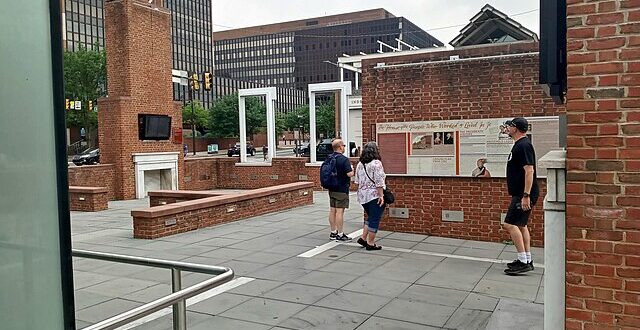
National Park Service employees last month abruptly removed the exhibit, which focuses on nine enslaved people held by Washington during his presidency while he lived in Philadelphia, then the nation’s capital. The site sits on Independence Mall, adjacent to landmarks tied to the nation’s founding.
The removal prompted a lawsuit by the city of Philadelphia and supporters of the exhibit, who argued that the action amounted to censorship and erased critical historical context.
Millions of visitors are expected to travel to Philadelphia this year ahead of the nation’s 250th anniversary in 2026, intensifying scrutiny over how American history is presented at federal historic sites.
In her ruling Monday, Rufe granted an injunction ordering the exhibit restored and barring Trump administration officials from creating new interpretations of the site’s history while the case is litigated.
Rufe, an appointee of former President George W. Bush, sharply criticized the administration’s actions, comparing them to the fictional totalitarian regime depicted in 1984 by George Orwell.
“As if the Ministry of Truth in George Orwell’s 1984 now existed, with its motto ‘Ignorance is Strength,’ this Court is now asked to determine whether the federal government has the power it claims — to dissemble and disassemble historical truths,” Rufe wrote. “It does not.”
The judge concluded that the removal of the exhibit likely violated constitutional protections and exceeded the government’s authority.
The Justice Department has said the executive branch retains broad discretion over exhibits at national parks and historic sites. In appealing Rufe’s decision, administration lawyers signaled they will challenge the court’s authority to dictate how historical narratives are presented on federal property.
The department did not immediately elaborate on the specific legal arguments it plans to advance before the appeals court.
The Philadelphia exhibit is among several instances in which the Trump administration has quietly removed or altered materials addressing the history of enslaved people, LGBTQ+ communities and Native Americans at federal sites.
Critics say the pattern reflects an effort to downplay aspects of U.S. history that conflict with the administration’s political messaging. Supporters of the administration argue that federal agencies should avoid what they describe as politicized interpretations of history.
The dispute comes as cultural institutions nationwide face renewed debates over how to present the nation’s founding era and the legacy of slavery.
The 3rd U.S. Circuit Court of Appeals will determine whether to uphold Rufe’s injunction while the underlying lawsuit continues.
Unless the appeals court intervenes, the exhibit on the enslaved people held by Washington is expected to remain in place as the case moves forward — potentially through the height of the nation’s semiquincentennial celebrations.