Poli Alert Politics & Civics
Related Articles



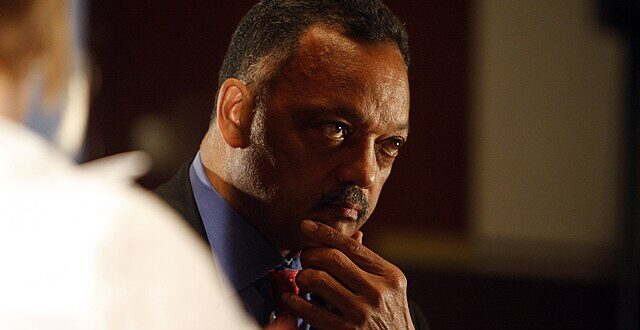
The Rev. Jesse Jackson, the civil rights leader who marched alongside Martin Luther King Jr. and later mounted two historic bids for president, has died, his family said Tuesday. He was 84.
Jackson died peacefully Tuesday morning surrounded by family, according to a statement. He had been hospitalized for observation in November. Doctors previously said he had been diagnosed with progressive supranuclear palsy, a degenerative neurological condition. In 2017, Jackson revealed he had Parkinson’s disease, which affects the nervous system and gradually limits movement.
“Our father was a servant leader — not only to our family, but to the oppressed, the voiceless, and the overlooked around the world,” the family said. “His unwavering belief in justice, equality, and love uplifted millions.”
Born Oct. 8, 1941, in Greenville, South Carolina, Jackson was raised by his mother, Helen Burns Struggs. As a teenager, he took the surname of his stepfather, Charles Jackson.
An honors student and athlete, Jackson earned a football scholarship to the University of Illinois before transferring to North Carolina Agricultural and Technical College, where he graduated in 1964. As the civil rights movement intensified, he left the Chicago Theological Seminary — three credits shy of a degree — to join King’s efforts.
Jackson became a trusted member of King’s inner circle and worked with the Southern Christian Leadership Conference, the nonviolent protest organization led by King. In 1968, Jackson was in Memphis, Tennessee, when King was assassinated at the Lorraine Motel.
That same year, Jackson was ordained by the Rev. Clay Evans. Decades later, in 2000, Chicago Theological Seminary awarded him a Master of Divinity degree in recognition of his life’s work.
After King’s death, Jackson founded Operation PUSH — People United to Save Humanity — and later established the Rainbow PUSH Coalition, which became a national platform for civil rights advocacy, voter engagement and economic empowerment. The organizations merged in 1996.
Political Ambitions and Legal Advocacy
Jackson’s national profile grew through both activism and electoral politics. In 1984 and again in 1988, he sought the Democratic presidential nomination, becoming one of the first Black candidates to mount a competitive national campaign.
In 1984, Jackson won several state primaries and caucuses and finished third overall. His campaign was marred by controversy over remarks about New York’s Jewish community. Former Vice President Walter Mondale ultimately secured the nomination and lost to Republican President Ronald Reagan.
Jackson’s 1988 campaign proved even stronger, as he won multiple contests and finished second in the delegate count, helping expand the Democratic coalition and laying groundwork for greater minority participation in national politics.
Beyond electoral politics, Jackson engaged in high-profile diplomatic efforts, including advocating for the release of hostages abroad and lobbying for statehood for Washington, D.C. He later served as a special envoy under President Bill Clinton.
In 2000, Clinton awarded Jackson the Presidential Medal of Freedom, the nation’s highest civilian honor, recognizing decades of civil rights activism.
Jackson remained a visible political and moral voice into the 21st century. On election night in 2008, he was seen with tears in his eyes as Barack Obama was projected to win the presidency. Jackson later told CBS News that the moment reflected the sacrifices of civil rights leaders who “paid a price” to expand democracy in America.
Over the course of his life, Jackson received more than 40 honorary doctorate degrees, according to the Rainbow PUSH Coalition.
Jackson’s career spanned more than five decades, bridging the civil rights movement of the 1960s with modern electoral politics. His work in voter mobilization and coalition-building — particularly through the Rainbow Coalition — helped reshape the Democratic Party’s approach to minority outreach and social justice issues.
While sometimes a polarizing figure, Jackson was widely credited with elevating issues of racial inequality, economic justice and human rights on both domestic and international stages.
His family described his life as one devoted to “justice, equality, and human rights,” saying his commitment helped shape “a global movement for freedom and dignity.”
Public observances will be held in Chicago, his family said. Final arrangements for celebration of life services, including public events, will be announced by the Rainbow PUSH Coalition.
Jackson is survived by his wife of more than 60 years, Jacqueline, five children with her, another daughter, and a broad network of political leaders, activists and supporters influenced by his work.