Poli Alert Politics & Civics
Related Articles


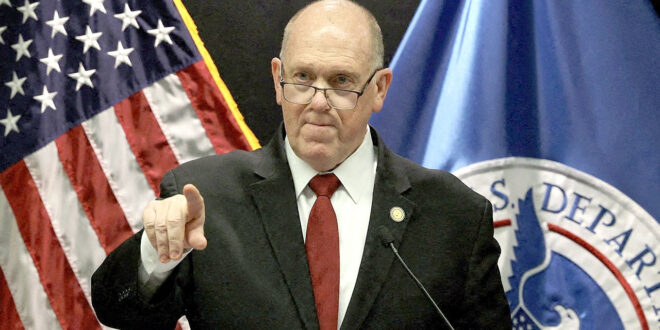
President Donald Trump’s border czar on Thursday announced an imminent end to Operation Metro Surge, a sweeping federal immigration crackdown that sent thousands of agents to Minnesota, sparked widespread protests and left two people dead.
Border Czar Tom Homan said the large-scale deployment would begin winding down within days, with most out-of-state agents returning home or being reassigned elsewhere.
“The Twin Cities, and Minnesota in general, are and will continue to be much safer for the communities here because of what we have accomplished under President Trump’s leadership,” Homan said at a morning news conference.
He said a “small footprint of personnel” would remain temporarily to conclude operations, including agents assigned to fraud investigations.
The announcement comes just over two weeks after Homan arrived in Minnesota to take control of the operation, which had escalated into one of the largest federal immigration enforcement actions in recent history.
Shootings and controversy
Since the start of the year, immigration agents have shot three people, killing two — Renee Good, a Minneapolis immigration observer, and Alex Pretti, an ICU nurse at the Minneapolis VA Medical Center.
The surge also drew allegations of racial profiling, enforcement actions at schools and churches, the detention of legal immigrants and minors, and the use of chemical irritants during protests. Local officials and civil rights advocates accused federal agents of creating chaos in residential neighborhoods, triggering high-speed chases and arresting journalists and activists. Some were later released without charges.
Minnesota Attorney General Keith Ellison, along with the cities of Minneapolis and St. Paul, sued the Trump administration in an effort to halt the operation, citing claims of racial discrimination and excessive force.
The operation proved deeply unpopular in the state. Nearly two-thirds of Minnesotans disapprove of how Immigration and Customs Enforcement is handling its job, according to a recent poll conducted by NBC News Decision Desk in partnership with KARE 11 and the Minnesota Star Tribune.
“President Trump didn’t send me here because the operations were being run and conducted perfectly,” Homan acknowledged.
Leadership change and drawdown
Homan took over from Border Commander Gregory Bovino, who had described agents as his “troops” and said the operation would continue “until there are no more of those criminal illegal aliens roaming the streets.”
Days after Homan’s arrival, the administration began scaling back the mission, pulling roughly 700 agents from Minnesota. Gov. Tim Walz said earlier this week he believed a full end to the surge was imminent after speaking with White House Chief of Staff Susie Wiles.
“They knew they needed to get out here but, in very Trumpian fashion, they needed to save face,” Walz said Thursday.
Walz said Minnesota now faces the task of repairing disruption to schools, businesses and immigrant communities.
U.S. Rep. Ilhan Omar, D-Minn., said ending the operation was insufficient, calling for investigations into the killings and broader accountability measures.
“We need justice and accountability,” Omar wrote on social media, calling for independent investigations and congressional action.
St. Paul Mayor Kaohly Her welcomed the announcement but expressed skepticism, noting a recent high-speed immigration enforcement chase in a densely populated neighborhood despite prior promises of a drawdown.
“Any announcement of a drawdown or end to Operation Metro Surge must be followed by real action,” Her said.
Arrest totals and transparency questions
The Department of Homeland Security said the operation grew to roughly 3,000 federal agents, calling it its largest deployment ever.
Homan touted approximately 4,000 arrests since the surge began in December, including individuals with violent criminal histories. However, he did not specify how many arrests were targeted enforcement actions focused on public safety threats.
Homeland Security has not released a comprehensive list of those arrested, instead publishing selected examples of individuals described as the “worst of the worst.” Some of those individuals were already in state custody before being transferred to federal detention.
Homan said local law enforcement cooperation had increased during the operation and praised Minnesota officials for maintaining order during protests. He reiterated that he would not request local sheriffs hold detainees beyond scheduled release times — a practice Minnesota’s attorney general has said would violate state law.
Political fallout and funding fight
The end of Operation Metro Surge comes as Congress remains deadlocked over proposed increases to Homeland Security funding — a standoff that could trigger a partial government shutdown.
A group of Minnesota residents traveled to Washington this week to urge lawmakers to deny additional funding for expanded immigration enforcement.
“We need real investigations, real oversight, real consequences when lives are lost,” Rochester Imam Salah Mohamed said outside the U.S. Capitol.
While Homan framed the drawdown as a mission accomplished, Democratic leaders in Minnesota say the political and legal battles over federal immigration enforcement are far from over.
Walz said the state made no concessions in exchange for the operation’s end.
“Nothing has changed,” he said. “Minnesota will continue to do what we do.”