 Poli Alert Politics & Civics
Related Articles


Democrats are threatening to block funding for the Department of Homeland Security unless Republicans agree to sweeping changes to Immigration and Customs Enforcement and other federal agencies carrying out President Donald Trump’s aggressive immigration enforcement campaign.
With DHS funding set to expire next week, Democratic leaders say they will withhold votes unless there are “dramatic changes” and “real accountability” following a series of controversial enforcement actions — including the fatal shootings of two protesters by federal agents in Minneapolis in January.
“We have to rein in ICE in very serious ways and end the violence,” Senate Majority Leader Chuck Schumer, D-N.Y., told reporters Wednesday. House Democratic leader Hakeem Jeffries of New York said Democrats are “drawing a line in the sand” as Republicans need Democratic votes to keep DHS operating.
The standoff comes as Congress debates whether and how to impose new restrictions on ICE and U.S. Customs and Border Protection amid growing public backlash to enforcement operations in Minnesota and other states. While some bipartisan interest exists in de-escalating tensions, GOP leaders warn that reaching agreement on complex policy changes in such a short window may be unrealistic.
“I don’t think it’s very realistic,” Senate Majority Leader John Thune, R-S.D., said Tuesday. “But there’s always miracles, right?”
Temporary extension, deep disagreements
President Trump last week agreed to separate DHS funding from a broader government spending package and extend it at current levels for two weeks to allow negotiations to continue. House Speaker Mike Johnson, R-La., said he was present when Trump spoke with Schumer and described the talks as “on the path to get agreement.”
Still, Republicans have signaled strong resistance to many of Democrats’ core demands, including requirements that immigration officers unmask and display identifying information, rely more heavily on judicial warrants, and coordinate enforcement actions with state and local authorities.
At the same time, GOP lawmakers are pushing to attach their own priorities to the DHS bill, including legislation requiring proof of citizenship to register to vote and new restrictions on so-called sanctuary jurisdictions — a loosely defined term for governments that limit cooperation with federal immigration authorities.
Democrats, meanwhile, face pressure from within their own party not to compromise with an administration they accuse of trampling constitutional rights.
Body cameras: rare point of overlap
One area of tentative agreement is the use of body-worn cameras. The DHS funding bill already includes $20 million to equip immigration officers with cameras, and Homeland Security Secretary Kristi Noem ordered body cameras issued to all DHS officers operating in Minneapolis earlier this week, with plans to expand the policy nationwide as funding allows.
Former Customs and Border Protection Commissioner Gil Kerlikowske said many agents support body cameras, noting they can help exonerate officers from false accusations. But he cautioned that questions remain over when cameras must be activated and how footage should be handled.
“When do you turn it on? And if you got into a problem and didn’t have it on, are you going to be disciplined?” Kerlikowske said. “It’s really pretty complex.”
Schumer said Democrats want firm rules requiring cameras to remain activated during enforcement actions.
Clash over masks and identification
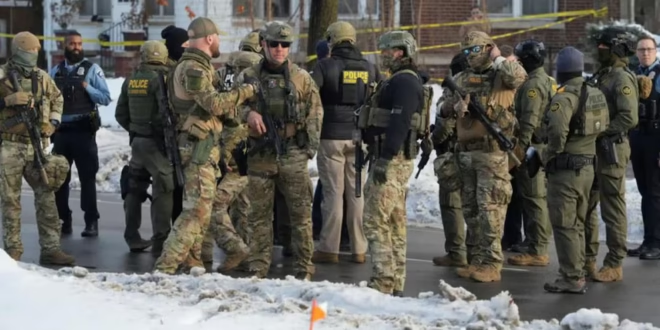
Masking has become one of the most contentious issues in the negotiations, fueled by viral images of masked federal agents conducting arrests and shootings.
Democrats argue that unmasking officers would improve accountability and public trust. Republicans counter that immigration officers face credible threats and harassment.
“Unlike your local law enforcement in your hometown, ICE agents are being doxed and targeted,” Johnson said Tuesday. “If you unmask them and put all their identifying information on their uniform, they will obviously be targeted.”
Federal regulations already require ICE officers to identify themselves “as soon as it is practical and safe to do so,” but immigration advocates say the rule is routinely ignored.
“We just see routinely that that’s not happening,” said Nithya Nathan Pineau, a policy attorney with the Immigrant Legal Resource Center.
Warrants and enforcement tactics
Democrats are also demanding tighter limits on immigration arrests, including greater reliance on judicial warrants rather than administrative warrants issued internally by DHS.
An internal ICE memo obtained last month authorized officers to forcibly enter residences using a narrow category of administrative warrants — a move civil liberties advocates say conflicts with Fourth Amendment protections.
House Democrats say they want to end roving patrols and stop enforcement actions at sensitive locations such as schools, hospitals and houses of worship.
Johnson rejected the proposal, saying Democrats are trying to impose “an entirely new layer” of judicial oversight that immigration agencies cannot accommodate. Still, he acknowledged that curbing roving patrols could be an area of potential compromise.
Accountability after shootings
Calls for oversight intensified after ICE agents shot and killed protester Renee Good in Minneapolis on Jan. 7. Federal authorities blocked state investigators from accessing evidence in the case, prompting Democratic Gov. Tim Walz to demand state involvement.
Democrats are now seeking a uniform code of conduct for all federal immigration agents and clearer mechanisms for independent investigations when force is used.
Late Wednesday, Schumer and Jeffries sent Republican leaders a list of what they described as “common-sense solutions that protect constitutional rights and ensure responsible law enforcement.”
Slim odds, rising stakes
Any agreement is unlikely to satisfy all Democrats. Rep. Ayanna Pressley of Massachusetts said she would oppose any deal that does not require unmasking officers.
“I ran for Congress in 2018 on abolish ICE,” Pressley said. “My position has not changed.”
With the funding deadline looming and midterm elections approaching, the standoff underscores the political and constitutional stakes surrounding Trump’s immigration crackdown — and raises the possibility of yet another high-profile funding fight on Capitol Hill.

