

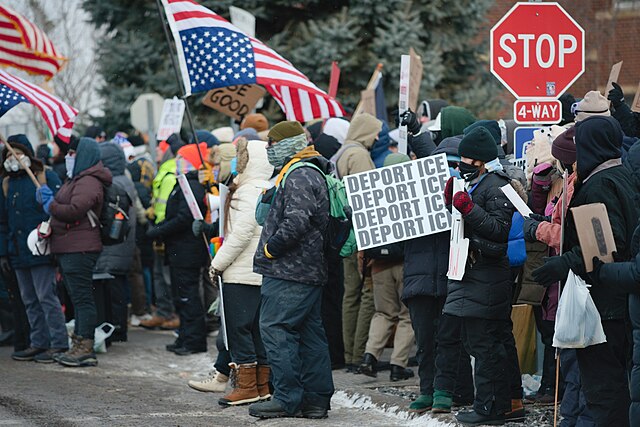
A sweeping government funding package is facing fresh obstacles in the Senate after a federal officer shot and killed a man in Minnesota over the weekend, deepening Democratic opposition to the Department of Homeland Security’s funding and raising the risk of a partial government shutdown next Friday at midnight.
The legislation, which has already passed the House, requires 60 votes in the Senate to advance. Republicans hold 53 seats, meaning they must secure support from at least seven Democrats — a threshold that now appears increasingly uncertain as lawmakers respond to the killing of Alex Jeffrey Pretti, a 37-year-old Minneapolis intensive care nurse.
Several Democrats who previously supported recent appropriations measures said they will vote against the bill unless Congress imposes new restrictions on how immigration officers conduct enforcement operations.
Democratic backlash over DHS funding
Senate Minority Leader Chuck Schumer, D-N.Y., said the Minnesota shooting underscores what he described as systemic abuses by immigration authorities.
“What’s happening in Minnesota is appalling — and unacceptable in any American city,” Schumer said in a statement. “Because of Republicans’ refusal to stand up to President Trump, the DHS bill is woefully inadequate to rein in the abuses of ICE. I will vote no.”
Schumer added that Senate Democrats would withhold votes to move forward with the broader funding package if the DHS measure remains included.
Sen. Catherine Cortez Masto, D-Nev., said she would oppose the Homeland Security portion of the bill, accusing the Trump administration of deploying “undertrained, combative federal agents” with little accountability.
“This is clearly not about keeping Americans safe,” she said. “It’s brutalizing U.S. citizens and law-abiding immigrants.”
Sen. Jacky Rosen, D-Nev., also announced her opposition, saying she would vote against any funding package that includes DHS money until “guardrails” are put in place to curb abuses of power and ensure transparency.
Sen. Tim Kaine, D-Va., who previously supported a bipartisan funding deal, said Congress should not validate a president who is “acting chaotically and unlawfully,” calling for significant amendments to the bill.
Additional Democrats opposing the DHS funding include Sens. Ruben Gallego and Mark Kelly of Arizona, Mark Warner of Virginia and Brian Schatz of Hawaii.
Republicans defend DHS, reject changes
Republican senators largely defended DHS and federal immigration officers following Pretti’s death, arguing that the agency must retain the resources needed to enforce immigration law.
GOP leaders have shown no indication they will separate DHS funding from the broader appropriations package, despite Democratic demands. A spokesperson for Senate Majority Leader John Thune, R-S.D., said the measures will move forward as a single bill.
That stance has complicated Democratic efforts to salvage the rest of the funding package, which includes less controversial provisions such as money for child care, mental health services, housing assistance and Pell Grants.
Some Democrats, including Cortez Masto, have urged Congress to decouple DHS funding and vote on it separately, but Republican leaders have resisted that approach.
Rising political stakes
The dispute is further complicated by a previously approved $170 billion infusion for immigration enforcement, which would remain available to the Trump administration even if DHS funding lapses.
Republicans will likely need at least eight Democratic votes if Sen. Rand Paul, R-Ky., continues his pattern of opposing appropriations bills.
Sen. Patty Murray, D-Wash., the top Democrat on the Senate Appropriations Committee, sharply criticized federal actions in Minnesota.
“This looks like an execution,” Murray wrote on social media. “There must be an investigation. There must be accountability.”
Sen. Chris Murphy, D-Conn., echoed that sentiment, calling the current enforcement strategy a “rampage” and urging Congress to reject funding without reforms.
Shutdown risk grows
With the Senate vote expected next week and negotiations stalled, lawmakers face mounting pressure to avert a shutdown while grappling with a broader political and legal battle over immigration enforcement, federal accountability and the limits of executive power.
Whether Congress can bridge the widening partisan divide before the funding deadline remains uncertain, but the Minnesota shooting has transformed what had been a difficult budget fight into a volatile national showdown.