Poli Alert Politics & Civics
Related Articles


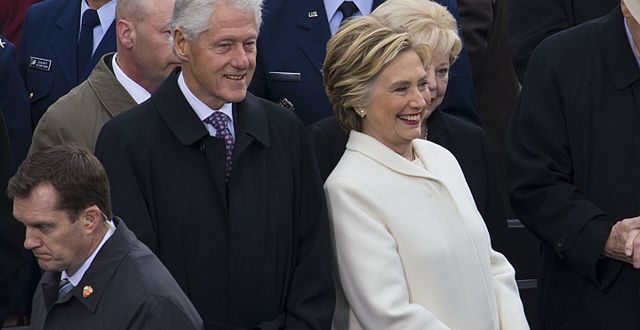
The House Oversight Committee voted Wednesday to hold former President Bill Clinton and former Secretary of State Hillary Clinton in contempt of Congress after the couple refused to appear for closed-door, transcribed depositions tied to the panel’s investigation into the late financier and convicted sex offender Jeffrey Epstein.
The resolution holding Hillary Clinton in contempt passed 28-15, largely along party lines, with three Democrats joining Republicans. A separate resolution holding Bill Clinton in contempt passed 34-8, drawing support from nine Democrats.
The votes clear the way for the full House to decide whether to refer the contempt findings to the Justice Department for possible prosecution, a step that could carry penalties of up to a year in prison if enforced. House Republican leaders are not expected to schedule a floor vote until lawmakers return in February following a weeklong recess, giving both sides time to negotiate or lobby ahead of a final decision.
Background of the investigation
The Clintons are among 10 individuals subpoenaed by the Oversight Committee as part of a months-long investigation into Epstein and his former associate, Ghislaine Maxwell. Epstein pleaded guilty in 2008 to prostitution-related charges, including one involving a minor, and was arrested again in 2019 on federal sex trafficking charges. He died in federal custody later that year in what officials ruled a suicide.
Judges and lawmakers have said Epstein abused and trafficked dozens of girls over decades. Maxwell was convicted in 2021 of sex trafficking-related charges and sentenced to 20 years in prison. Committee Chairman James Comer, R-Ky., said Wednesday that Maxwell is scheduled to sit for a deposition on Feb. 9.
Neither Bill nor Hillary Clinton has been accused of wrongdoing in connection with Epstein. A spokesman for the former president has said Bill Clinton met Epstein several times and took four trips on his private plane but was unaware of Epstein’s criminal activity. Bill Clinton has appeared in Epstein-related photographs released by Congress and the Justice Department.
Legal arguments and dispute over subpoenas
The Clintons declined to participate in depositions scheduled for Jan. 13 and 14, arguing that the committee’s subpoenas were “legally invalid.” In a letter sent Tuesday, their attorneys said the couple had already provided sworn written statements containing all relevant information they possessed and offered to sit for limited, untranscribed interviews in New York — an offer the committee rejected.
“The failure to schedule the sessions confirms that these subpoenas are not grounded in any legislative purpose; instead they are being weaponized for harassment and political gain,” the attorneys wrote.
Comer said the proposed conditions were unacceptable because they would limit participation to only himself, the committee’s top Democrat and a small number of aides, while barring transcription.
“The House Oversight Committee’s bipartisan subpoenas require the Clintons to appear for depositions that are under oath and transcribed,” Comer said in a statement. He also cited Bill Clinton’s past impeachment and disciplinary history, saying the former president has “a documented history of parsing language to evade questions.”
The Clintons were originally scheduled to appear in October, with the dates later moved to December and then again to January after the couple said they planned to attend a funeral, according to committee aides.
Government and political response
Democrats on the committee met privately Tuesday night to discuss strategy, according to three people familiar with the conversations who spoke on condition of anonymity. By Wednesday, party leaders concluded several members would support contempt, despite last-minute efforts to dissuade them.
Democratic Reps. Melanie Stansbury of New Mexico, Summer Lee of Pennsylvania and Rashida Tlaib of Michigan voted in favor of both contempt resolutions. Reps. Greg Casar and Jasmine Crockett of Texas did not vote on either measure.
The office of Rep. Robert Garcia of California, the committee’s ranking Democrat, did not respond to a request for comment.
“By voting to hold the Clintons in contempt, the Committee sent a clear message: no one is above the law,” Comer said.
Broader context
Contempt of Congress has historically been rare but has been used more frequently in recent years. In 2021, lawmakers cited Stephen K. Bannon and Peter Navarro for defying subpoenas issued by the House committee investigating the Jan. 6, 2021, Capitol attack. Both later served four-month prison sentences.
The Oversight Committee’s inquiry is one of two congressional efforts to force broader disclosure of Epstein-related records. A bipartisan push led by Reps. Thomas Massie, R-Ky., and Ro Khanna, D-Calif., resulted in a law requiring the Justice Department to release files from its Epstein investigation by Dec. 19.
The department missed that deadline, citing the need to review and redact millions of documents. Massie and Khanna asked U.S. District Judge Paul A. Engelmayer to appoint a special master to oversee the release, but Engelmayer ruled Wednesday that he lacked jurisdiction to grant the request.
Next steps
The House will decide next month whether to formally refer the contempt findings against the Clintons to the Justice Department. In the meantime, committee leaders say they remain open to testimony that complies with subpoena requirements, while the Clintons maintain that they have already cooperated fully.
“There is no plausible explanation for what you are doing other than partisan politics,” the Clintons wrote in a letter explaining their refusal to appear. “To say you can’t complete your work without speaking to us is simply bizarre.”