Poli Alert Politics & Civics
Related Articles


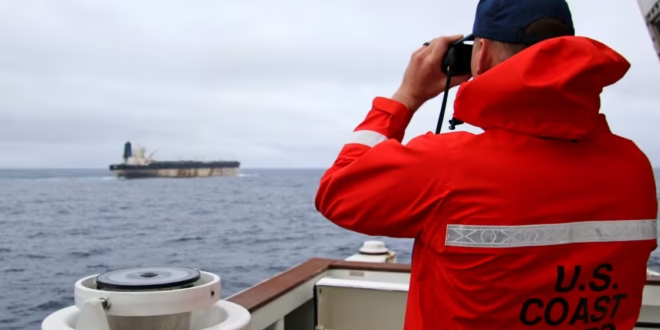
The United States has seized a Russian-flagged oil tanker in the North Atlantic following a dramatic weeks-long pursuit across international waters, sharply escalating tensions with Moscow as the Trump administration intensifies its global blockade of Venezuelan oil.
U.S. officials confirmed early Wednesday that American forces boarded and seized the tanker now known as the Marinera— formerly the Bella 1 — after tracking it since last month, when it fled waters near Venezuela while under U.S. sanctions. The seizure was carried out pursuant to a U.S. federal court warrant, according to U.S. European Command.
In a parallel operation, U.S. Southern Command announced the seizure of a second sanctioned vessel, the M/T Sophia, which it described as a “stateless dark fleet tanker” engaged in illicit activity in the Caribbean Sea.
The Kremlin condemned the action, accusing the United States of violating international maritime law and warning that Washington had crossed a dangerous line by using force against a vessel sailing under the Russian flag.
Sanctions Enforcement Goes Global
U.S. European Command said the Marinera was intercepted in the North Atlantic after weeks of monitoring by the Coast Guard cutter Munro. Defense Secretary Pete Hegseth amplified the announcement on social media, declaring that “the blockade of sanctioned and illicit Venezuelan oil remains in FULL EFFECT — anywhere in the world.”
Homeland Security Secretary Kristi Noem described the operation as one of “two safe, effective boardings within hours,” portraying the pursuit as a prolonged cat-and-mouse chase. She said the tanker attempted to evade capture by changing its name, repainting its hull and switching flags while being pursued across rough seas.
The Bella 1 had been on the U.S. sanctions list since June 2024 and was among a cluster of tankers operating near Venezuela after Washington imposed a sweeping blockade following its surprise military operation that led to the capture of Venezuelan President Nicolás Maduro.
Russian Backlash
Russia’s Transport Ministry said the vessel had been granted temporary authorization to sail under the Russian flag in late December and accused the United States of violating the principle of freedom of navigation.
“The high seas are governed by international law, and no state has the right to use force against vessels duly registered under another state’s jurisdiction,” the ministry said, adding that communication with the ship was lost after U.S. forces boarded it.
The Russian Foreign Ministry said it was “closely monitoring” the situation and demanded the humane treatment and prompt return of Russian citizens aboard the tanker. A senior Russian lawmaker, Andrei Klishas, accused the United States of engaging in “outright piracy on the high seas.”
Military Movements Raise Stakes
The seizure unfolded amid unusually visible U.S. military movements in and around the North Atlantic. Flight-tracking data showed at least 13 U.S. Air Force C-17 transport aircraft flying from American bases to the United Kingdom over the weekend, while multiple surveillance and patrol aircraft operated near the tanker’s last known position off the coast of Scotland.
Those aircraft included Navy P-8A Poseidon maritime patrol planes, Air Force U-28A surveillance aircraft, C-130J transports and a KC-135 refueling tanker.
Britain’s Ministry of Defence acknowledged providing “pre-planned operational and surveillance support” for the interception, citing intelligence assessments that linked the vessel to illegal activity and networks associated with international crime and terrorism, including Hezbollah.
Shadow Fleet Under Scrutiny
The seizures highlight Washington’s growing focus on what officials describe as a “dark fleet” of tankers used to move sanctioned oil while obscuring ownership and destination. U.S. authorities say several sanctioned vessels operating near Venezuela have recently reflagged to Russia in an apparent effort to evade enforcement.
At least three other tankers — previously sailing under flags of Comoros and Guyana — have recently re-registered under the Russian flag, according to maritime records.
Geopolitical Fault Lines
President Donald Trump said Tuesday that Venezuela would hand over between 30 million and 50 million barrels of oil to the United States, framing access to the country’s vast reserves as central to his administration’s strategy — and a growing source of friction with Russia and China.
The seizure of the Marinera now represents one of the most direct confrontations yet between Washington and Moscow over sanctions enforcement, raising the risk that the administration’s Venezuela policy could spill into a broader maritime and diplomatic clash.