Poli Alert Politics & Civics
Related Articles


President Donald Trump said Wednesday that he is abandoning — at least for now — his effort to deploy National Guard troops to Chicago, Los Angeles and Portland, Oregon, after courts repeatedly blocked the moves.
“We will come back, perhaps in a much different and stronger form, when crime begins to soar again — only a question of time!” Trump wrote in a social media post.
The president had sought to deploy National Guard troops to all three cities over the objections of Democratic governors and mayors, framing the move as part of a broader crackdown on crime, immigration and protests during his second term.
Governors typically control their states’ National Guard units, and Trump’s efforts to federalize the troops triggered legal challenges in each jurisdiction.
Trump has made law-and-order policies a centerpiece of his presidency and has publicly floated invoking the Insurrection Act to override court rulings he views as obstacles. He has also described his approach as a political asset ahead of the 2026 midterm elections.
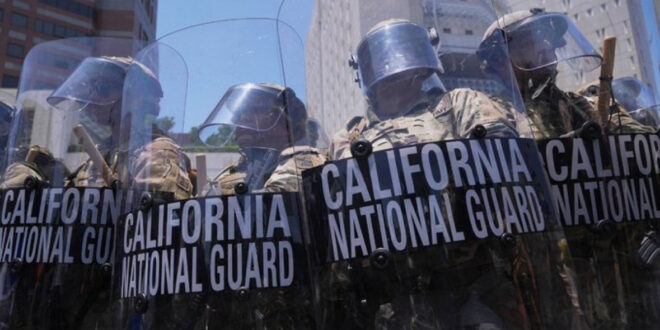
Troops had already been withdrawn from Los Angeles following a series of court rulings. In Chicago and Portland, Guard units were never deployed to city streets as legal challenges stalled the effort.
In his post, Trump claimed that the mere presence of troops led to crime reductions in all three cities. But city officials disputed that assertion.
When Chicago challenged the deployment in court, a Justice Department lawyer said the Guard’s mission would be limited to protecting federal property and personnel, not reducing overall crime. Chicago officials said Tuesday that the city recorded 416 homicides in 2025 — the lowest total since 2014 — crediting local law enforcement and violence-prevention programs.
Portland Mayor Keith Wilson’s office similarly said declines in crime were the result of local policing and public safety strategies, not federal intervention.
Governors Push Back
Trump’s efforts suffered a major setback in December, when the Supreme Court declined to allow the administration to deploy National Guard troops in the Chicago area. While not a final ruling, the decision was a rare and notable defeat for the president.
Illinois Gov. JB Pritzker said Wednesday that Trump was “forced to stand down” after Illinois challenged what he called an attempt to militarize American cities.
In Oregon, hundreds of federally deployed National Guard troops were sent to Portland, but a federal judge barred them from operating on city streets. A permanent injunction issued in November blocked the deployment entirely.
Oregon Gov. Tina Kotek said Wednesday that her office had not yet received formal notice that the remaining troops would be demobilized.
“They were never lawfully deployed to Portland and there was no need for their presence,” Kotek said. “If President Trump has finally chosen to follow court orders and demobilize our troops, that’s a big win for Oregonians and for the rule of law.”
Trump’s first use of federalized Guard troops during his second term occurred in Los Angeles in June, after protests erupted over a surge in immigration arrests. He deployed roughly 4,000 Guard members and 700 Marines to protect federal buildings and later assist federal agents.
The deployment gradually scaled down. Troops were removed from city streets by mid-December after a lower court ruling ordered control returned to California Gov. Gavin Newsom. An appeals court later lifted a temporary pause, and on Wednesday the U.S. Court of Appeals for the Ninth Circuit formally ordered control of the Guard returned to Newsom.
“About time he admitted defeat,” Newsom wrote on social media. “The federal takeover of California’s National Guard is illegal.”
Troops Remain Elsewhere
Despite the pullback in several cities, National Guard troops remain deployed elsewhere.
In Washington, D.C., the U.S. Court of Appeals for the District of Columbia Circuit in December paused a lower court order that would have ended the deployment of Guard troops sent after Trump declared a “crime emergency” in August.
In Memphis, Tennessee, Trump ordered National Guard troops deployed in September as part of a federal crime task force. While a judge initially blocked the deployment, the ruling was stayed pending appeal, allowing the troops to remain.
In New Orleans, about 350 National Guard troops arrived Tuesday in the French Quarter and are scheduled to remain through Mardi Gras. The deployment has the backing of Louisiana’s Republican governor and the city’s Democratic mayor.