Poli Alert Politics & Civics
Related Articles


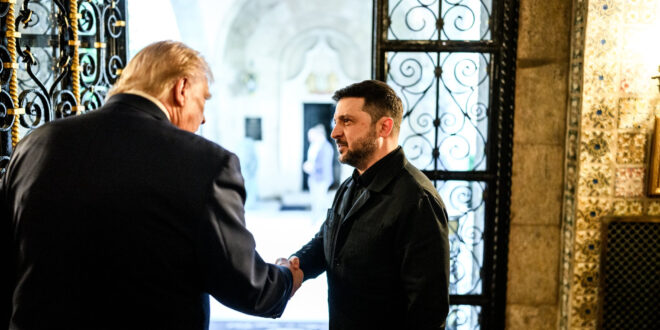
President Donald Trump and Ukrainian President Volodymyr Zelenskyy said Sunday that negotiations to end Russia’s war in Ukraine are nearing completion, but offered no concrete breakthroughs after a high-stakes face-to-face meeting that underscored how unresolved the most contentious issues remain.
Speaking after their talks at Trump’s Mar-a-Lago property, both leaders struck an optimistic tone while acknowledging that significant obstacles — particularly territory and security guarantees — have yet to be resolved.
“You can say 95%, but I don’t like to say percentages,” Trump told reporters. “There are one or two very thorny issues, very tough issues. But I think we’re doing very well.”
Zelenskyy said discussions focused on what he called a nearly finished peace framework, describing security guarantees involving the United States, Europe and Ukraine as “almost agreed.” He added that a 20-point peace plan under negotiation was “90% ready.”
Despite the upbeat rhetoric, neither leader announced a finalized agreement or detailed concessions, and officials provided few specifics about how longstanding disputes would be settled.
Territory remains central dispute
Trump identified land — particularly Ukraine’s eastern Donbas region — as the most difficult issue.
“I think the land you’re talking about, some of that land has been taken,” Trump said. “Some of that land is maybe up for grabs.”
Russia has demanded that Ukraine formally cede territory seized since its 2022 invasion, a condition Kyiv has repeatedly rejected. Zelenskyy reiterated Sunday that Ukraine has not agreed to give up sovereign territory, though he has signaled limited openness to compromise through demilitarized zones monitored by international forces.
The U.S. floated a proposal earlier this month to create a “free economic zone” in contested regions, but Zelenskyy said at the time that there was no shared understanding on the issue.
No ceasefire agreement
Trump confirmed that Russia has not agreed to a ceasefire — a key goal for Ukraine and its allies — saying it is “one of the points we’re working on right now.”
Russian President Vladimir Putin opposes a temporary ceasefire, arguing it could allow Ukraine to regroup militarily, according to Kremlin officials. Trump said he understood Moscow’s position.
Hours before meeting Zelenskyy, Trump said he spoke by phone with Putin in what he described as a “good and very productive” call. Kremlin aide Yuri Ushakov confirmed the conversation lasted more than an hour and included discussions about a potential peace deal.
Trump said he plans to speak with Putin again after Sunday’s talks.
European role emphasized
Trump and Zelenskyy said they briefed European leaders following their meeting. European Commission President Ursula von der Leyen said the call reflected “good progress” but stressed that “ironclad security guarantees from day one” would be essential.
French President Emmanuel Macron said European nations prepared to provide security guarantees — known as the “Coalition of the Willing” — will meet in Paris next month to finalize commitments.
Trump said a security agreement would be reached, with European countries playing a major role. “There will be a security agreement,” he said. “It’ll be a strong agreement.”
Talks follow renewed Russian strikes
The meeting came less than 48 hours after Russia launched a massive missile and drone assault on Kyiv, killing at least one person and injuring more than 20, according to Ukrainian officials. Zelenskyy said the barrage involved nearly 500 drones and 40 missiles.
“Russia continues to mock our cities and people,” Zelenskyy said, calling for increased pressure on Moscow.
Putin has signaled that Russia will continue its military campaign if negotiations fail, and has repeatedly blamed Ukraine and its Western allies for prolonging the war.
Long road to a deal
Sunday’s meeting was the fourth between Trump and Zelenskyy this year, following months of uneven diplomacy since Trump returned to office. A February White House meeting between the two leaders ended in a tense confrontation.
Trump campaigned on a promise to end the war quickly, at times claiming he could resolve it “on day one,” later calling that language an exaggeration. On Sunday, he described the conflict as “very complex” and negotiations as “very difficult.”
Zelenskyy said negotiating teams will continue working in the coming weeks, with Trump expected to host further talks, possibly in Washington.
For now, officials say progress is real but fragile — with the hardest decisions still unresolved as fighting continues.