Poli Alert Politics & Civics
Related Articles


The Supreme Court on Tuesday rejected a Trump administration request to deploy National Guard troops to the Chicago area while a legal challenge proceeds, dealing a setback to President Donald Trump’s effort to use federalized forces in Illinois to support immigration enforcement.
In an unsigned order, the high court left in place a lower-court ruling that bars the federal government from putting National Guard members on the streets of Chicago and surrounding areas. The decision appears to have been 6–3, with Justices Clarence Thomas, Samuel Alito and Neil Gorsuch dissenting.
The administration had argued that federal courts lack authority to review the president’s decision to bring state National Guard units under federal control. The Supreme Court declined to pause the lower-court order, concluding that the government had not met its burden to justify the deployment under Title 10 of U.S. law.
“At least in this posture,” the court said, the administration failed to show that Title 10 permits the president to federalize the Guard “in the exercise of inherent authority to protect federal personnel and property in Illinois.”
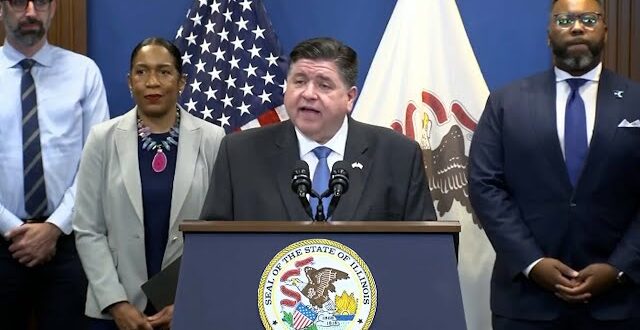
Illinois Gov. JB Pritzker called the ruling “a big win for Illinois and American democracy,” while Chicago Mayor Brandon Johnson said the court had “rebuked President Trump’s attempts to militarize and demonize our city.”
The White House said the ruling did not undermine the president’s broader agenda. “Nothing in today’s ruling detracts from that core agenda,” said spokeswoman Abigail Jackson, adding that the administration would continue working to enforce immigration laws and protect federal personnel.
Dispute over federal authority
The case stems from Trump’s decision earlier this fall to federalize the Illinois National Guard amid protests surrounding immigration enforcement operations in the Chicago area. The president claimed federal facilities had come under coordinated assault that hindered enforcement of immigration laws.
Title 10 allows the president to federalize the Guard when U.S. laws cannot be executed with “regular forces” or when there is a rebellion or threat of rebellion. Roughly 300 Illinois Guard members prepared to mobilize, and Guard units from Texas and California briefly arrived in the state before later departing.
Pritzker objected, arguing there was no public safety breakdown warranting military involvement. Illinois and the city of Chicago sued, seeking to block the deployment.
U.S. District Judge April Perry granted a temporary order barring the deployment, writing that there was “no showing that the civil power has failed” and calling federal assertions about unrest “unreliable.”
A divided panel of the U.S. Court of Appeals for the 7th Circuit later allowed the Guard to remain under federal control but upheld the prohibition on deploying troops in the Chicago area. The appeals court said the administration failed to meet the legal conditions for invoking Title 10, emphasizing that “political opposition is not rebellion.”
Supreme Court reasoning
In its order, the Supreme Court suggested that “regular forces” likely refers to the U.S. military, which is generally barred from domestic law enforcement under the Posse Comitatus Act except in limited circumstances.
“Those circumstances are exceptional,” the court said, concluding that the administration had not identified lawful authority for the military to execute the laws in Illinois.
The administration had argued that violence and threats near federal facilities forced the Department of Homeland Security to divert resources and that Guard troops were needed to protect officers and property. Illinois officials countered that local and state law enforcement had effectively managed demonstrations and warned that military deployment could escalate tensions.
Broader legal fight
The ruling comes amid a series of legal challenges to Trump’s use of the National Guard in cities including Los Angeles, Portland and Washington, D.C. Federal courts have issued conflicting rulings, with the 7th and 9th Circuits split on whether the Guard may be deployed into cities — though both agree courts may review the president’s use of Title 10 authority.
In Washington, a federal judge ruled last month that Trump’s Guard deployment violated federal law, though that decision has been temporarily paused pending appeal.
The Supreme Court’s action keeps the Illinois deployment blocked as litigation continues, underscoring unresolved questions about presidential power, federalism and the domestic use of military forces.