

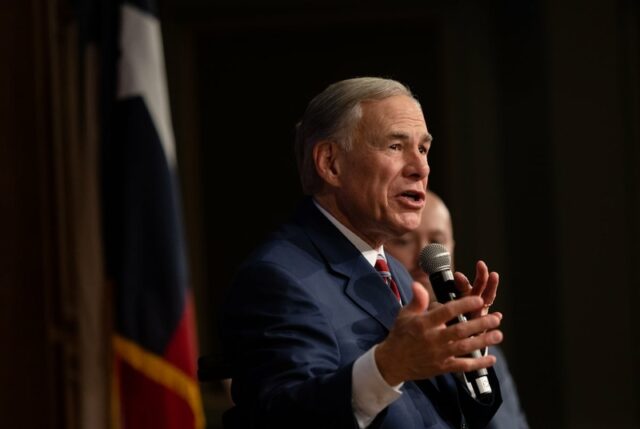
In a major win for President Donald Trump and Republican lawmakers, the Supreme Court on Thursday granted Texas’ emergency application to use a new congressional map drawn to increase GOP representation in next year’s midterm elections, pausing a lower-court ruling that had found the plan unlawfully relied on race.
The unsigned order — which appeared to carry a 6-3 conservative majority — put the lower court’s decision on hold while the justices consider the case. The three liberal justices strongly dissented, warning that the court’s action undercuts the ability of trial courts to police racial discrimination in redistricting.
“The district court did everything one could ask,” Justice Elena Kagan wrote in a dissent. She said the lower court found “substantial evidence” that legislators used race as a driving factor, not merely politics, and that the Supreme Court’s intervention short-circuited a reasoned fact-finding process.
The map, enacted by the Republican-led Texas Legislature at Gov. Greg Abbott’s direction, was designed to convert as many as five districts into reliably Republican seats. A three-judge federal court had struck down the map on grounds that lawmakers impermissibly used race when reshaping several districts — an action the court said violated the Constitution’s equal-protection guarantee.
“Federal courts have no right to interfere with a State’s decision to redraw legislative maps for partisan reasons,” Texas Attorney General Ken Paxton said in a statement after the order. The Trump administration, through the Justice Department, urged the justices to allow the map to stand, arguing courts should not displace legislative judgment close to an election.
House Minority Leader Hakeem Jeffries, D-N.Y., blasted the decision. “The Supreme Court has shredded its credibility by rubber-stamping a racially gerrymandered map,” he posted on X, saying Democrats would fight back by pursuing their own mapmaking efforts and litigation in other states.
Justice Samuel Alito, while concurring with the order, urged challengers to produce an alternative map showing that Texas’ partisan goals could have been achieved without race, saying plaintiffs had not met that burden. “That failure gives rise to a strong inference that the state’s map was indeed based on partisanship, not race,” he wrote.
Civil-rights groups that challenged the map condemned the ruling. Thomas Saenz, president of the Mexican-American Legal Defense and Educational Fund, warned the order could encourage “guerrilla tactics” by legislatures that delay redistricting until courts are more reluctant to intervene so close to an election.
Legal scholars and voting-rights advocates said the decision raises practical and constitutional questions. Because the Supreme Court’s order stays the lower court’s injunction, Texas can proceed with its new lines while the case moves through the high court, potentially affecting candidate filing, campaign strategy and voter registration in a state that will likely remain central to control of the U.S. House.
The Texas litigation — one of several mid-decade redistricting fights driven by Republican efforts to shore up House gains — is likely to reach the full merits stage. The Supreme Court’s temporary reprieve does not decide the underlying constitutional claims and sets up a high-stakes review of how race and politics may lawfully interact in drawing congressional districts.
“This is politics through the map,” said one voting-rights attorney who asked not to be named. “If the court ultimately blesses this approach, it will reshape the playing field for years to come.”
What happens next: The Supreme Court will consider fuller briefing and argument on whether Texas’ map is a racial gerrymander in violation of the 14th Amendment. Meanwhile, campaigns and state officials must scramble to prepare ballots and outreach under an uncertain legal timeline that could change again before next November.