

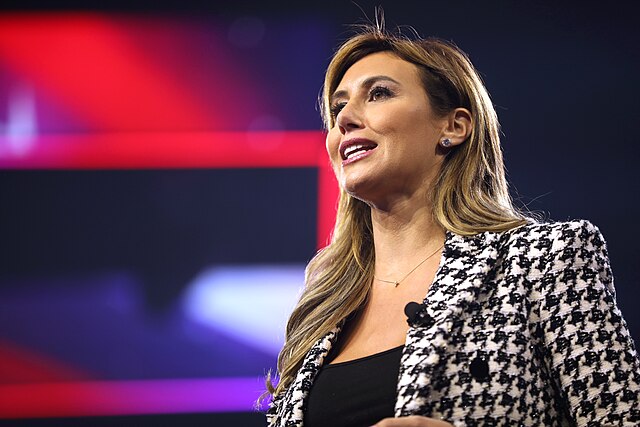
A federal appeals court on Monday ruled that Alina Habba, President Donald Trump’s former personal attorney, has been serving unlawfully as the U.S. attorney for New Jersey, delivering a significant legal rebuke to the administration’s handling of high-level federal appointments.
In a unanimous decision, a three-judge panel of the 3rd U.S. Circuit Court of Appeals affirmed a lower court’s finding that the administration violated federal law when it relied on a series of improvised maneuvers to install Habba in the role after failing to secure Senate confirmation.
“Under the Government’s delegation theory, Habba may avoid the gauntlet of presidential appointment and Senate confirmation and serve as the de facto U.S. Attorney indefinitely,” the panel wrote. “This view is so broad that it bypasses the constitutional process entirely.”
The ruling marks the first appellate-level challenge to the Trump administration’s approach to installing U.S. attorneys without Senate approval and could reshape similar disputes across the country. Although the 3rd Circuit’s jurisdiction covers New Jersey, Pennsylvania, Delaware and the U.S. Virgin Islands, federal appellate decisions are often treated as persuasive authority nationwide, especially on novel separation-of-powers issues. The case could ultimately reach the U.S. Supreme Court.
The administration has faced mounting setbacks in district courts as well. Judges in the Central District of California and in Nevada recently found that the administration’s U.S. attorneys were also serving unlawfully; both cases are under appeal. In New York, a district judge last week threw out two indictments after determining that Lindsey Halligan, the U.S. attorney for the Eastern District of Virginia who had been temporarily assigned to serve in the Northern District of New York, lacked lawful authority.
Despite the rulings, federal criminal prosecutions have generally continued. Judges overseeing the affected districts have mostly declined to dismiss indictments, reasoning that other authorized prosecutors participated in the cases. Some trials, however, have been delayed while courts sort through the legality of the appointments.
The New Jersey case stemmed from a challenge to the administration’s reliance on interim appointment powers, special attorney designations and internal Justice Department delegations. Trump named Habba interim U.S. attorney earlier this year. As her 120-day interim term approached its expiration — and amid growing indications that district judges would not appoint her to a permanent term — Habba resigned.
Attorney General Pam Bondi then named Habba a special attorney and designated her as first assistant U.S. attorney, subsequently delegating to her the full authority of the U.S. attorney’s office.
Judge Matthew Brann, whose ruling the appeals court upheld, wrote that this chain of actions was designed to circumvent statutory limits on interim appointments and avoid the Senate confirmation process. Trump administration lawyers argued that Brann misunderstood the statute and that Habba’s delegated authority from Bondi was sufficient to legitimize her role.
The appeals court disagreed. It found that Habba could not lawfully serve because she was not the first assistant U.S. attorney at the moment the vacancy arose — a prerequisite under the governing federal vacancy statute. The panel also rejected the administration’s argument that delegating authority to a special attorney could substitute for statutory appointment procedures.
The ruling now places pressure on the Justice Department to address ongoing challenges throughout the federal system, where multiple U.S. attorney appointments remain in legal limbo.
Legal experts said Monday’s decision could limit the administration’s flexibility in filling vacancies quickly, particularly in districts where Senate support for nominees has been uncertain.
The Justice Department has not said whether it will seek review from the Supreme Court. The White House did not immediately respond to a request for comment.