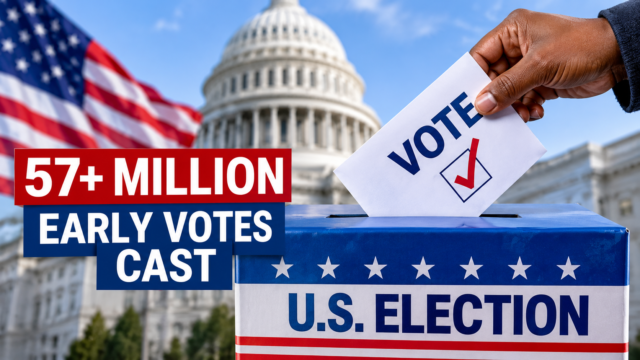
Control of Congress is on the line Tuesday as voters decide all 435 House seats, 35 Senate seats and governorships in 36 states. More than 57 million Americans had already voted early, according to the University of Florida Voting Lab.
Republicans hold the Senate 53 to 47. In the House, Republicans hold 218 seats plus an independent who usually votes with them, Democrats hold 214, and two seats are vacant, CBS News reported. A party needs 218 of the 435 House seats for a majority. CBS News identified 47 battleground House districts, and its Battleground Tracker estimate on October 25 had Democrats on track for 229 seats, within a range of 215 to 237. A tracker like that is a projection built from polls and other data, not a result.
In the Senate, CBS News named 11 key races. Eight seats are held by Republicans: Alaska, Iowa, Kansas, Maine, North Carolina, Ohio, South Carolina and Texas. Three are held by Democrats: Georgia, Michigan and New Hampshire.
The political news that affects your wallet, your rights and your vote, broken down in plain language. Free in your inbox.
In Texas, polls show a tight Senate race between Democrat James Talarico and Republican Ken Paxton, and the governor’s race between Republican Greg Abbott and Democrat Gina Hinojosa could also be close, CBS News reported. In Maine, Republican Sen. Susan Collins faces Democrat Troy Jackson.
Alaska’s Senate race has an unusual wrinkle. A candidate named Daniel J. Sullivan shares a nearly identical name with the sitting Republican senator, Dan Sullivan. The New York Times reported that members of Democrat Mary Peltola’s campaign recruited him, but Peltola said she knew nothing about it, CBS News reported. Alaska uses ranked choice voting, where voters rank candidates in order of preference. If no one wins a majority at first, the last place candidate is dropped and those votes move to each voter’s next choice until someone passes 50 percent.
Results come in after polls close at different times across the country, and Poli Alert will report a result only once an official source or major news outlets have called it. Races that are close, or that use ranked choice counting, can take longer. Voters can confirm their polling place, hours and ID rules with their state or county election office, such as the Florida Department of State or the Georgia secretary of state’s office.