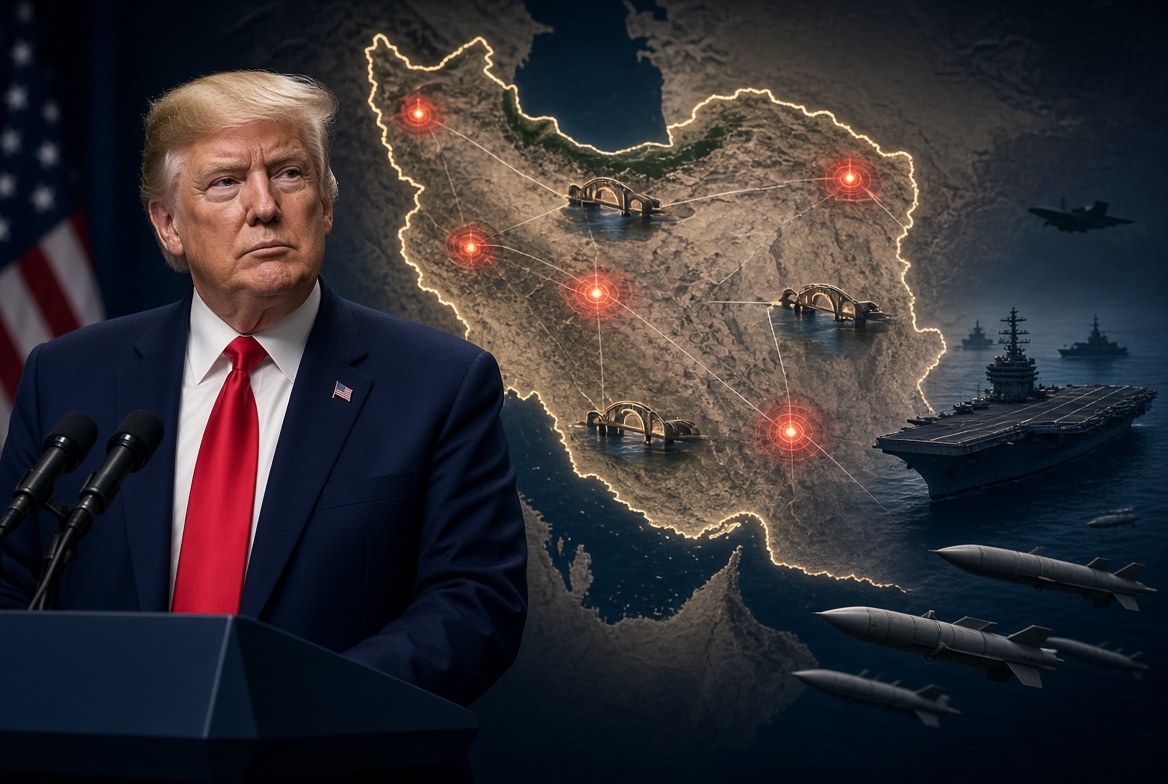
Trump told CNN on Sunday that new Iran strikes are “highly unlikely” as long as negotiations keep moving, then used the same interview to describe exactly how he would hit the country if they don’t.
“It depends on whether or not they sign a very strong agreement,” Trump told CNN’s Jim Sciutto during a 20 minute phone call. “The answer is highly unlikely it’s going to be necessary.” He repeated some version of “highly unlikely” five times over the course of the conversation.
In between those reassurances, he laid out the backup plan. Trump said the US has already picked out infrastructure targets inside Iran, including power plants and bridges. “We have 38 bridges in our site that we can knock down in literally one hour,” he said. “They’ll all be down.”
The political news that affects your wallet, your rights and your vote, broken down in plain language. Free in your inbox.
He added that he would rather not follow through, since rebuilding would take Iran about 10 years. “I don’t like ripping down bridges,” Trump said. “And the hardest thing to build is a bridge. It takes years, and I’m a good builder.”
He also made clear the military is in place if he changes his mind about Iran strikes. “We’re ready for it. I’ve got three aircraft carriers here,” he said, describing them as “fully locked and loaded.”
The war is now eight months old, and the two sides have been stuck in a stalemate with little fighting and little real diplomatic progress. Meanwhile, Iran has attacked oil tankers moving through the Strait of Hormuz, the narrow waterway between Iran and Oman that a large share of the world’s oil passes through. When shipping there gets disrupted, gas prices go up everywhere. Trump’s comments landed on the same day both the US and Iran reported that ships had been hit in or near the strait.
The talks are being mediated by Qatar, and neither country, nor Qatari officials, has said much publicly about where negotiations stand. The two biggest sticking points are Iran’s nuclear program, which Tehran says it needs for energy, and who controls the strait. Those are the same two issues Trump tied to whether Iran strikes resume.
Trump spent much of the interview arguing that Iran is in no position to hold out. He called it “a failing nation” and claimed Iran’s inflation hit 301% this year. He said Iran’s air defenses have been wiped out and claimed the country is down to about 10% of its missile capacity and 15% of its drone capacity because “much of their factories are gone.” None of those figures have been independently verified. “They want to make a deal so badly,” he said.
Iran is under real economic pressure. US sanctions have made it hard for the country to sell its crude oil on world markets, and billions of dollars in Iranian assets sitting in foreign banks have been frozen.
The interview also comes less than a week after the midterm elections, where the war’s unpopularity with voters helped fuel Republican losses. Iranian hardliners have pointed to those results as a sign that Trump is weakened and more likely to give in on the nuclear program and the strait.
Diplomatic activity across the region has picked up since Tuesday’s vote. Qatar said Friday that Trump called Qatari Emir Sheikh Tamim bin Hamad Al Thani to talk about calming tensions. A day earlier, Iran’s Foreign Minister Abbas Araghchi spoke with his counterparts from Saudi Arabia, the United Arab Emirates, Oman, Pakistan, Kuwait, Jordan, Turkey, Cyprus and Qatar.
Trump has sent mixed messages about ending the war before, and he left the door open again on Sunday. “I would if necessary, but we hit them really hard,” he said of new Iran strikes. “They’re withering away financially. We’ve hit them militarily. We could finish them off.”