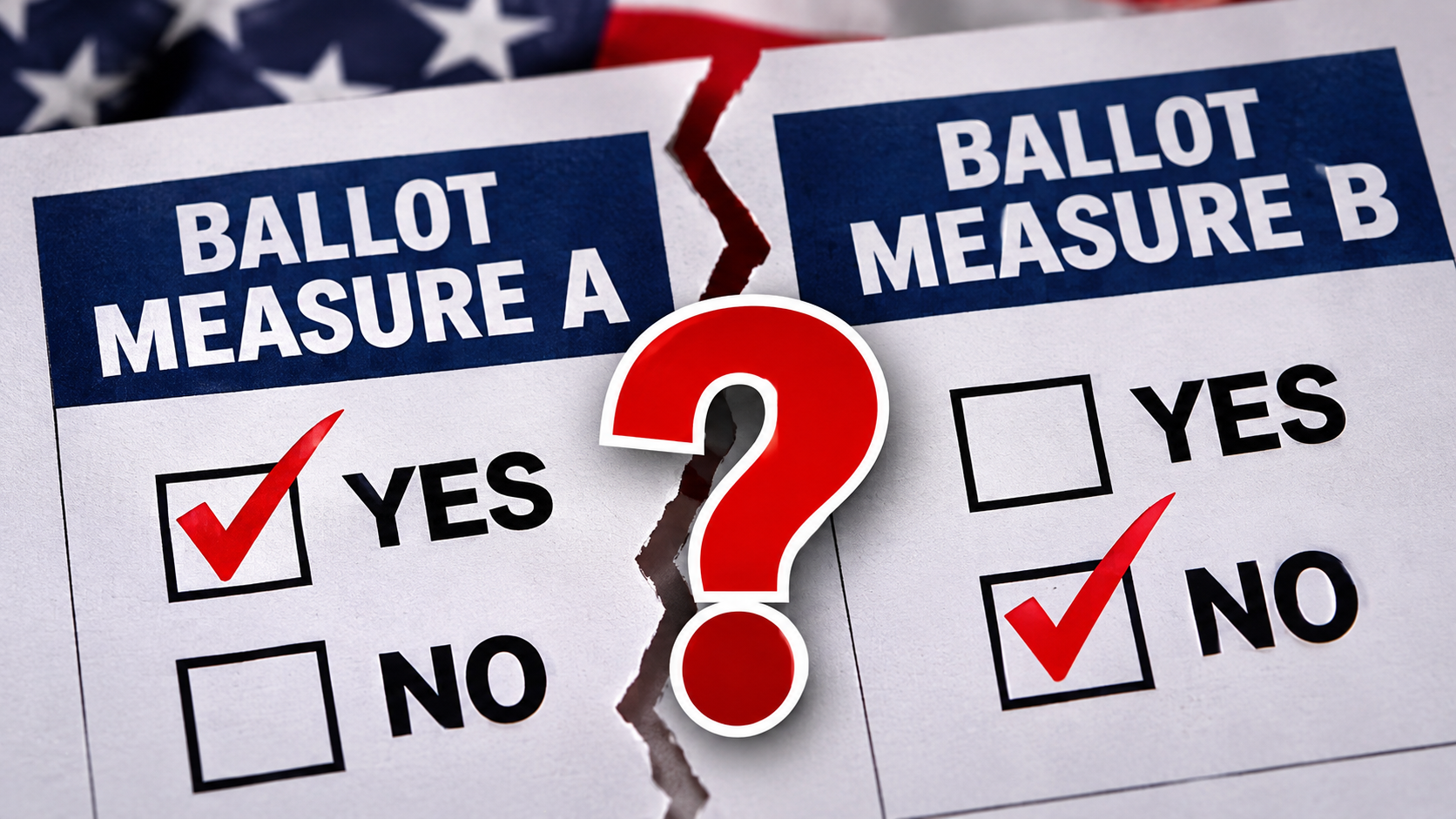
Conflicting ballot measures are settled by a simple rule in many states: if two measures that clash both pass, the one with more yes votes wins the part where they collide.
A ballot measure is a proposed law or constitutional change that goes straight to voters instead of through the legislature. A single election can put several of them in front of the same people, and sometimes they cover the same subject. Two groups with different ideas about housing, taxes or elections can each write their own version and collect enough signatures to put it on the ballot. Sometimes one measure is written on purpose to undercut another.
Nothing stops voters from approving both. Each measure gets its own vote, and a person can mark yes on two proposals that point in opposite directions, either by choice or because the wording was hard to follow. When both pass, the state has two new rules that cannot both be followed in full.
The political news that affects your wallet, your rights and your vote, broken down in plain language. Free in your inbox.
States handle this in their own ways, so the answer depends on where the vote happens. California’s constitution says that when provisions of two or more measures approved at the same election conflict, the measure that receives the highest number of yes votes prevails. Other states have their own rules in their constitutions or election laws, and the state election office is the place to confirm how a particular state handles it.
The tie breaker applies only to the parts that actually conflict. If a measure has twenty provisions and only two of them collide with another measure, the other eighteen can still take effect. Deciding whether two measures truly conflict is often a legal question, and it can end up in court. A judge may have to read both measures line by line and rule on which sections stay and which are set aside.
The rule matters most when the vote totals are close, because the measure with fewer yes votes can lose its disputed provisions even though a majority of voters approved it. A measure that passes with 52 percent can lose to a rival that passes with 55 percent.
California offers a live example from the 2026 election. Proposition 40 on the November 3 ballot would impose a one time 5 percent tax on the wealth of Californians with a net worth of $1 billion or more, the San Francisco Standard reported. Propositions 41 and 42 would block certain new state taxes. The Public Policy Institute of California, a research group, said both could effectively cancel Proposition 40 even if voters approved it. In that situation, the vote counts on each measure would decide which one controls the tax question.
This affects ordinary voters in a practical way. A yes vote on one measure can be undone by a yes vote on another, so the ballot has to be read as a whole instead of one question at a time. The official voter guide from the state, which is mailed to voters in many states and posted by the secretary of state, usually says if a measure was written to compete with another. After the election, the final outcome of competing measures is not known until every ballot has been counted and the results are certified, which is the official sign off by election officials that the totals are accurate. In a close race between rival measures, that can take days or weeks, and a court challenge can add more time.