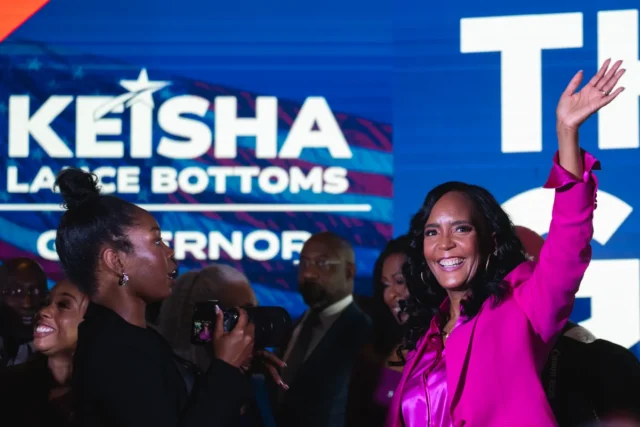
Democrats scored a sweeping victory in the November 3 midterm elections, taking control of both chambers of Congress, flipping key Republican-held governorships and making history in races across the country.
The results mark a major shift in the balance of political power in Washington and state governments, giving Democrats control of the legislative branch for the final two years of Donald Trump’s second term.
Democrats gained at least seven Senate seats and 18 House seats, with additional races still being counted Wednesday morning. The party’s victories also extended beyond Congress, reaching traditionally Republican states where Democratic candidates defeated GOP incumbents and nominees.
The political news that affects your wallet, your rights and your vote, broken down in plain language. Free in your inbox.
The Democratic victories included several races that had appeared difficult for the party just two years earlier. Democrats won Senate seats in Kansas, Iowa, Texas, Ohio, Maine, North Carolina and South Carolina. The victories in Kansas and Iowa were particularly significant because both states had supported Trump in the 2024 presidential election.
The gubernatorial results also delivered a major shift. Democrats flipped four Republican-held governor’s offices:
-
Georgia: Keisha Lance Bottoms defeated Republican Rick Jackson, becoming the first Black woman elected governor in American history and Georgia’s first Democratic governor since 1998.
-
Iowa: Rob Sand defeated Republican Zach Lahn, returning the governor’s office to Democratic control for the first time in two decades.
-
Ohio: Amy Acton defeated Republican Vivek Ramaswamy, giving Democrats their first Ohio gubernatorial victory since 2006.
-
Texas: Gina Hinojosa defeated incumbent Republican Greg Abbott, giving Democrats their first Texas gubernatorial victory since Ann Richards won in 1990.
Historic representation also featured prominently in the results. Democrat Peggy Flanagan won a Minnesota Senate race, becoming the first Native American woman elected to the U.S. Senate. Abdul El-Sayed won in Michigan, becoming the first Muslim elected to the Senate. Democrats also positioned House Minority Leader Hakeem Jeffries to potentially become the first Black speaker of the House when the new Congress convenes in January.
The victories extend beyond federal offices. Democrats gained control of five state legislative chambers, including the North Carolina House, Wisconsin Senate, Wisconsin Assembly, Pennsylvania Senate and Minnesota House, according to Ballotpedia’s preliminary election analysis.
The election results also reflect voter concerns about the economy and the direction of the federal government.
The Associated Press Voter Poll found that frustration over high prices, inflation, the war in Iran and concerns about government corruption weighed heavily on voters. The survey also found that roughly seven in 10 voters believed Congress was not doing enough to provide checks and balances on Trump.
Economic concerns were especially significant. Trump’s 2024 campaign included promises to bring down prices and improve the economy. But voter dissatisfaction with the cost of living became a major challenge for Republican candidates seeking to defend their congressional majorities.
Trump attempted to distance himself from the Republican losses, telling Fox News that Democrats ran good campaigns but insisting the results were not a personal rejection of him. He also blamed some Republican candidates for their defeats.
What Happens Next
The Democratic takeover of Congress will substantially change the political environment for the remainder of Trump’s term.
With control of the House and Senate, Democrats will have greater authority to determine which legislation receives consideration, block Republican priorities and exercise congressional oversight of the administration.
Oversight includes congressional investigations, hearings and subpoenas seeking documents and testimony from government officials. Democratic lawmakers are expected to use those powers to scrutinize administration policies and decisions.
The change will also affect federal judicial and executive branch nominations. Senate Democrats will have greater influence over whether Trump’s nominees advance, while House Democrats will control committee leadership and investigative priorities.
For Black Americans, the election results also bring historic representation into several important positions. The possibility of Jeffries becoming the first Black speaker of the House would represent another major milestone, while Bottoms’ victory in Georgia puts a Black woman in a governor’s office for the first time in American history.
However, historic representation does not automatically translate into policy changes. Voters will be watching whether the new Democratic majorities address issues including voting rights, health care, housing affordability, economic opportunity and federal protections against discrimination.
The new Congress is scheduled to convene January 3, 2027. Until then, election officials will continue processing outstanding ballots and finalizing results in races that remain uncalled.
Tuesday’s results have already changed the balance of power in Washington. The next test for Democrats will be whether they can turn their electoral victories into legislative action.