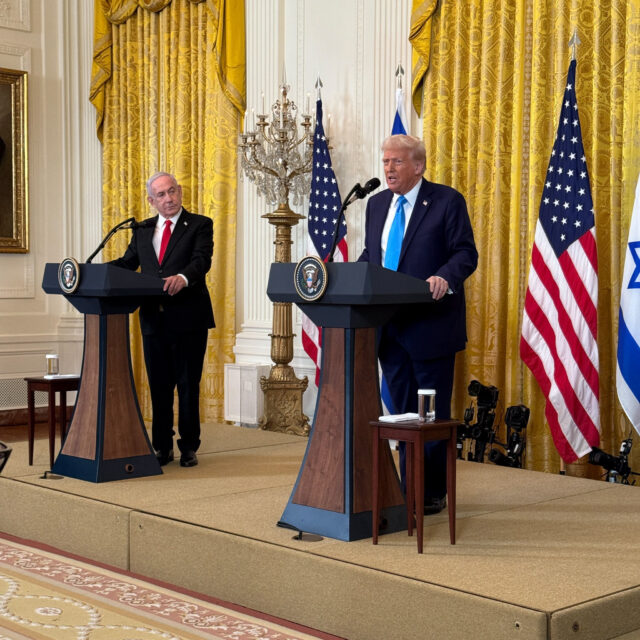
Donald Trump says the United States will stop sending billions of dollars in annual military assistance to Israel by the end of 2026, claiming he reached an agreement with Israeli Prime Minister Benjamin Netanyahu to end the funding after years of American financial support.
Trump made the announcement Tuesday morning during a phone interview with Fox News’ Fox & Friends, saying the United States would no longer provide Israel with approximately $4 billion annually.
“Now, as far as paying Israel, Bibi Netanyahu and I have made a deal that we give Israel $4 billion a year, and we made a deal months ago that we’re stopping,” Trump told the network.
The political news that affects your wallet, your rights and your vote, broken down in plain language. Free in your inbox.
“We’ve already agreed that by the end of this year we won’t be paying Israel. Now we’ll help Israel if they need it,” he added.
Trump said Netanyahu approached him about ending the financial assistance and that the two leaders had discussed the possibility for several years.
The announcement does not mean the United States is ending its military relationship with Israel. Trump indicated that Israel would still be able to purchase American weapons, suggesting that the relationship could shift away from direct military assistance toward commercial weapons sales.
Trump argued that Israel has become economically successful enough to operate without the annual assistance. He also acknowledged that American funding for Israel has become a political issue for Democrats, including Abdul El-Sayed, the Democratic candidate for U.S. Senate in Michigan.
The timing of Trump’s announcement is significant because it comes as Republicans and Democrats face voters in the November midterm elections, with U.S. support for Israel becoming an increasingly divisive issue in American politics.
El-Sayed, who has criticized unconditional American military assistance to Israel, has made the issue part of his Senate campaign. Trump specifically referenced the Michigan Democrat while discussing the political debate surrounding U.S. funding.
A $38 Billion Military Assistance Agreement
The United States has provided Israel with billions of dollars in military assistance under a 10-year agreement negotiated in 2016 during the Obama administration.
The agreement covers fiscal years 2019 through 2028 and outlines $38 billion in assistance. That includes $3.3 billion annually in Foreign Military Financing, which helps Israel purchase American-made military equipment, and $500 million annually for cooperative missile defense programs.
The Congressional Research Service explains that the agreement is a memorandum of understanding, rather than a legally binding treaty. Congress still controls annual appropriations, meaning lawmakers have a role in determining whether the money is provided.
Trump’s announcement raises questions about whether the administration intends to end the existing arrangement early or negotiate a different military relationship with Israel.
Netanyahu had already expressed interest in reducing Israel’s dependence on American military assistance. In January 2026, he told The Economist that he wanted to gradually eliminate the assistance over the next decade. He also discussed the possibility of ending the funding during a May interview with CBS News’ 60 Minutes.
However, Netanyahu’s previously stated goal involved a gradual reduction over 10 years, not an immediate cutoff at the end of 2026.
What Happens Next?
There are still unanswered questions about how Trump’s announcement would be implemented.
Reuters reported Tuesday that neither the White House nor Netanyahu’s office had immediately responded to requests for comment. It also reported that the precise funding covered by Trump’s announcement remains unclear.
Although Trump says the two leaders reached an agreement, no publicly confirmed details have established how the existing assistance arrangement would be changed.
For now, the announcement signals a potential shift in one of America’s longest-standing military partnerships. Whether the United States actually ends the annual assistance by December 31 will depend on the administration’s next steps and the decisions made through the federal budget and congressional appropriations process.