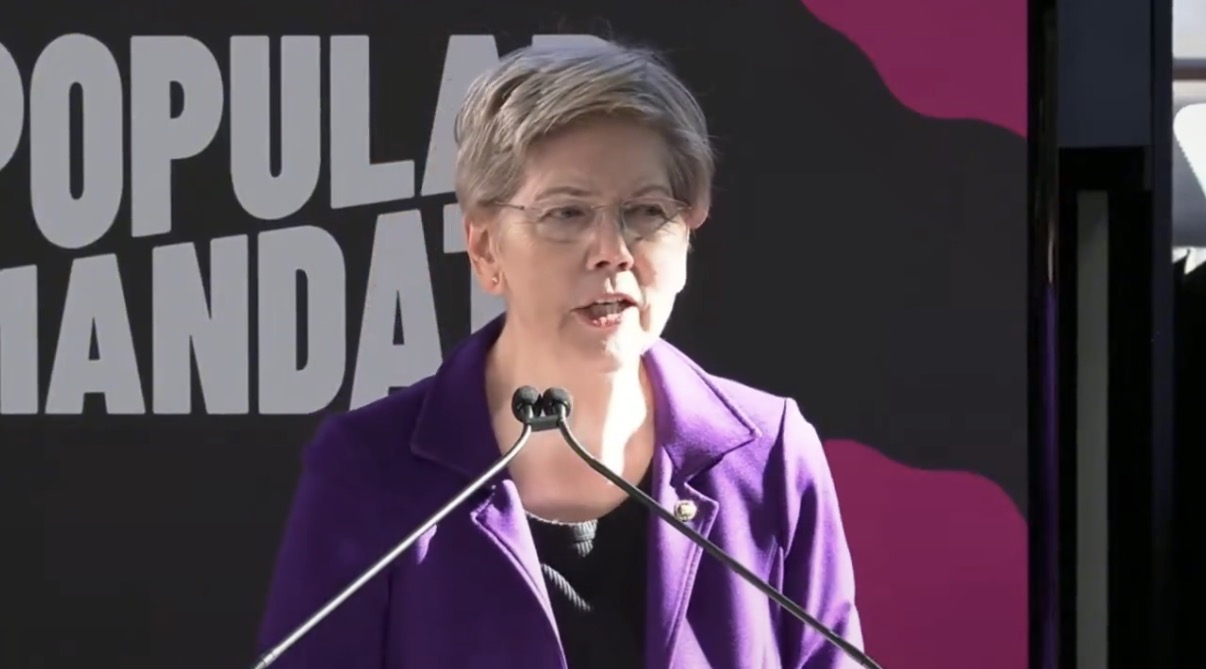
Sen. Elizabeth Warren is urging Democrats to use their congressional power to advance legislation addressing the cost of living and force Donald Trump to decide whether to sign or veto proposals that could directly affect millions of American households.
Warren, a Massachusetts Democrat, is calling for an aggressive legislative agenda centered on raising the federal minimum wage, restricting corporate price gouging and banning certain uses of artificial intelligence that allow companies to charge consumers different prices based on their personal information.
“Democrats must deliver popular, meaningful legislation to Trump’s desk, and then dare him to veto it,” Warren said.
The political news that affects your wallet, your rights and your vote, broken down in plain language. Free in your inbox.
“Dare him to veto an increase to the minimum wage for hard-working Americans. Dare him to veto a ban on price gouging. Dare him to veto a ban on AI surveillance pricing,” she continued, adding, “You can’t win what you don’t fight for.”
Her comments outline a strategy of using Congress to put economic proposals before Trump, rather than allowing disagreements over his administration’s agenda to dominate the legislative debate.
Warren’s approach would require Democrats to move beyond campaign promises and introduce legislation that establishes specific policy choices for the White House.
One of her central proposals is increasing the federal minimum wage, which has remained at $7.25 per hour since 2009. Although many states and cities have adopted higher minimum wages, workers in states that follow the federal standard can still legally be paid that amount.
A full-time employee earning $7.25 an hour for 40 hours a week makes approximately $15,080 annually before taxes. That figure falls below the federal poverty guideline for a two-person household in the contiguous United States.
Raising the federal minimum wage would directly affect workers earning below the proposed new standard, including employees in retail, food service and other lower-paying industries. The size of any increase and its economic effects would depend on the legislation Congress ultimately considers.
Warren also wants Congress to address price gouging, a term generally used to describe excessive price increases, particularly during emergencies or periods of disrupted supply.
Federal legislation targeting price gouging could establish new restrictions on certain corporate pricing practices, although the details would determine which businesses and transactions are covered.
Such proposals have generated disagreements over how to distinguish unlawful price manipulation from price increases caused by higher production costs, supply shortages or changing consumer demand.
Another major target is AI surveillance pricing, a practice in which businesses use artificial intelligence and consumer data to determine how much an individual customer may be willing to pay.
Companies can potentially use information about purchasing habits, browsing activity, location and other personal characteristics to customize prices. Warren has raised concerns that these systems could allow businesses to charge different customers different amounts for the same product or service.
A ban would require lawmakers to define which forms of data collection and personalized pricing are prohibited, as well as which federal agencies would enforce the restrictions.
Warren’s legislative strategy would also face significant procedural obstacles.
Even with control of Congress, Democrats would need sufficient votes to pass legislation through both chambers. Most legislation in the Senate can face a filibuster, a procedure that generally requires 60 votes to end debate and advance toward a final vote.
If Congress passes a bill, Trump could sign it, veto it or allow it to become law without his signature under certain circumstances. Overriding a presidential veto requires a two-thirds vote in both the House and Senate.
That means delivering legislation to Trump’s desk would not guarantee that any of Warren’s proposals become law.
However, a veto would create a formal presidential record on the specific legislation, while a signature would enact the measure. Lawmakers could also use congressional hearings, committee proceedings and floor votes to establish where members stand on the proposals.
Warren’s remarks come as Democrats debate how to translate electoral gains into legislative priorities, particularly on economic issues that affect working families.
Her proposals focus on household expenses, wages and corporate pricing practices, areas where federal policy can have direct consequences for workers and consumers.
For Warren, the immediate objective is to turn those policy debates into legislative action.
Her message to fellow Democrats is that advancing economic legislation should remain a priority even when the White House is expected to oppose it.
“You can’t win what you don’t fight for,” Warren said.