


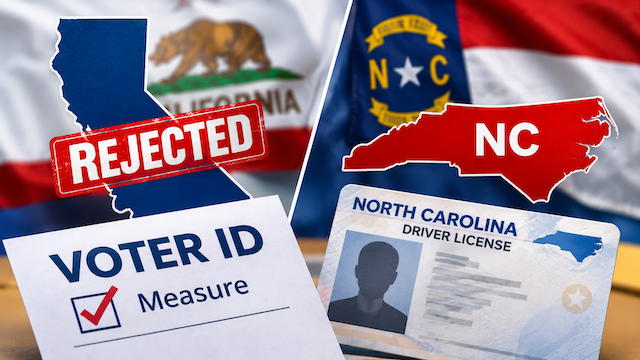
Voter ID rules took two different paths on Tuesday, as California voters rejected a voter ID measure and North Carolina voters approved a constitutional amendment that requires photo identification from every voter, including people who vote by mail.
In California, Proposition 39 failed with about 60 percent of voters opposed, according to the Associated Press, as reported by KPBS. The Associated Press called the race when 49 percent of the votes had been counted. The measure would have required government issued identification for in person voting and the last four digits of an ID number on mail ballots. The California Republican Party and the Howard Jarvis Taxpayers Association backed it, and supporters raised about 37 million dollars, KPBS reported. Opponents included the ACLU, Common Cause and the League of Women Voters of California, who argued that noncitizen voting is rare and that the rules could keep eligible voters from casting ballots, such as people who recently moved or changed their names. Gov. Gavin Newsom also campaigned against the measure. California Secretary of State Shirley Weber has said fraud claims are unfounded, and the state’s nonpartisan Legislative Analyst’s Office estimated that carrying out the measure would cost tens of millions to the low hundreds of millions of dollars.
In North Carolina, the photo ID amendment had about 59.5 percent support with 92.76 percent of precincts reporting at 10:50 p.m. Tuesday, according to the Carolina Journal, which cited unofficial results from the North Carolina State Board of Elections. A constitutional amendment is a change to a state’s founding document, and voters must approve it. This one extends the constitutional photo ID requirement to all voters, including those who vote by mail. Current state law already asks mail voters to include a copy of an ID or an ID exception form, but that rule is written in statute, not in the constitution. Voters approved two tax amendments the same night, and the Carolina Journal reported that all three take effect once the State Board of Elections certifies the results, scheduled for Nov. 24.
The political news that affects your wallet, your rights and your vote, broken down in plain language. Free in your inbox.
The two results come in a country where most states already have some form of voter ID. The National Conference of State Legislatures counts 36 states other than California that require or recommend voter ID in some form, and 10 of those are considered strict, KPBS reported.
Results in both states are unofficial until election officials certify them. Voters can confirm the voter ID rules that apply to them with the California Secretary of State’s office, the North Carolina State Board of Elections or their county election office.

