Poli Alert Politics & Civics
Related Articles



Republicans control virtually every lever of federal power. They hold the White House, both chambers of Congress and a Supreme Court with a 6-3 conservative majority that includes three Trump appointees.
Republicans also control some of the country’s most consequential battleground states.
Yet when voters complain about grocery bills, a weakening job market, immigration policy or the war in Iran, the response from Republican leaders increasingly sounds less like a governing agenda and more like an exercise in assigning blame.
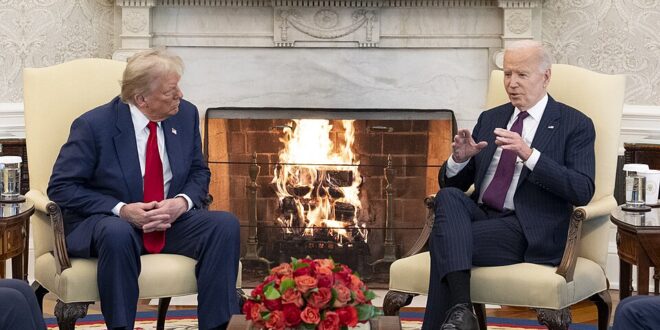
President Donald Trump and his allies continue to point to the Biden administration for problems that have persisted — or emerged — well into Trump’s second term.
On Sunday, White House economic adviser Kevin Hassett blamed former President Joe Biden for high grocery prices while dismissing a disappointing September jobs report as an outlier. The report showed employers adding fewer jobs than expected, raising fresh questions about the strength of the labor market.
Trump has made the same argument repeatedly.
Last month, he wrote on Truth Social that price increases were caused by “Sleepy Joe Biden,” not Trump. He has also claimed that grocery prices have “come way down from Biden.”
The numbers tell a different story.
Grocery prices are higher than when Trump returned to the White House, and overall inflation remains above the level he inherited. Whatever responsibility the Biden administration bears for inflation during its final years, Republicans now control the policies governing taxes, trade, regulation, energy and federal spending that influence prices.
That makes the continued focus on Biden increasingly difficult to separate from the political realities of an approaching midterm election.
Republicans running against their own record
The same dynamic is playing out in states where Republicans have held power for years.
In Ohio, Republicans have controlled the governor’s office and legislature since 2011. The party has dominated statewide elections for decades.
Yet Republican gubernatorial candidate Vivek Ramaswamy is campaigning on the promise of a “fresh approach,” arguing that Ohio is broken after years of Republican control.
That creates an obvious political problem: If the state is failing, voters can reasonably ask who has been running it.
Texas presents an even longer-running version of the same contradiction.
No Democrat has won statewide office there in more than three decades. Republicans have built one of the country’s most durable political machines while controlling the governor’s office, legislature and most statewide offices.
Ken Paxton, the Republican attorney general seeking the GOP nomination for U.S. Senate, has portrayed himself as an outsider willing to challenge Washington.
His campaign rhetoric emphasizes independence. Paxton has said he has “never bent the knee.”
But leaked audio has offered a less autonomous picture of his campaign, with Paxton acknowledging that he does not control the campaign’s messaging and saying decisions come from Washington.
The tension is familiar: Republicans can run against the establishment even when their own party is the establishment.
The party in power
That contradiction is even harder to ignore in Washington.
Republicans control the presidency and Congress. The Supreme Court has a conservative majority that Trump helped shape, and the justices have repeatedly intervened in major disputes involving the administration.
The court opened its new term this week after siding with Trump on a series of emergency applications.
Just last week, the justices allowed the administration, at least temporarily, to deport migrants to countries that were not listed in their removal orders — potentially sending people to nations with which they have no connection.
Whatever one’s view of those policies, they are not being imposed by an opposition party without power.
They are decisions being made by an administration with Republican control of the federal government behind it.
That distinction matters.
A political party can spend years blaming the opposition for inherited problems. But eventually, voters expect the party in power to own the consequences of its decisions.
An aging party making decisions for a younger generation
There is another uncomfortable feature of today’s Republican leadership: many of the people making decisions with consequences that will last decades are among the oldest leaders in American political history.
Trump, 80, is the oldest president ever inaugurated.
Sen. Chuck Grassley, 93, is president pro tempore of the Senate and third in line to the presidency.
Supreme Court justices, meanwhile, routinely serve well into their 70s and 80s. The average age at which justices have retired in recent decades has been around 81.
Age itself is not a measure of competence or legitimacy. But it does raise a question about political accountability when decisions involving national debt, health care, climate policy, Social Security, immigration, war and federal spending will affect Americans for generations.
The people making those decisions will not necessarily be around to live with their long-term consequences.
Younger Americans will.
They will inherit the federal debt, the cost of today’s wars, the infrastructure decisions being made now and the economic consequences of policies that may take years to fully emerge.
The midterm test
Republicans have a straightforward political argument available to them: They inherited serious problems and need more time to fix them.
But that argument becomes harder to sustain the longer they remain in power.
Republicans now control Washington. They control the machinery of government. They control numerous state governments, including states where their candidates have held power for a generation.
That means the central question for voters is changing.
It is no longer simply whether Republicans can identify what is wrong with the country.
It is whether they can fix it.
Blaming Biden may still energize the Republican base, but it does not change who is making the decisions today.
And as the 2026 midterm elections approach, voters have an increasingly simple question to ask the party in power:
If Republicans control the government, who exactly are they waiting for to fix it?