Poli Alert Politics & Civics
Related Articles


A federal appeals court on Thursday rejected the Trump administration’s latest effort to revive new U.S. Postal Service requirements for mail ballots, leaving the rules blocked as the Supreme Court considers whether they can take effect before the November midterm elections.
The 1st U.S. Circuit Court of Appeals upheld a preliminary injunction issued by U.S. District Judge Indira Talwani, concluding that the administration had not shown that the Postal Service’s new rules were lawful or that allowing them to take effect would avoid widespread disruption to the election.
The three-judge panel said the administration had not seriously challenged Talwani’s finding that implementing the requirements so close to Election Day could cause “chaos and widespread voter disenfranchisement.” The judges also said there was no evidence in the record of past mail-voting fraud or a likelihood of fraud connected to the Nov. 3 election.
The ruling is the latest setback for an administration that has repeatedly asked the Supreme Court to intervene in the dispute.
The high court has not yet ruled on the administration’s latest request, which was filed Sunday after Talwani issued her preliminary injunction Sept. 4. The Supreme Court docket shows the case, United States Postal Service v. California, is now before the justices on an emergency stay application.
Appeals Court Questions USPS Authority
The First Circuit focused heavily on whether the Postal Service has legal authority to impose election-related requirements on states without specific authorization from Congress.
The judges agreed with Talwani that the rule likely regulates the “manner of holding elections for members of Congress,” an area governed by the Constitution’s Elections Clause.
That clause gives states the initial authority to set the times, places and manner of congressional elections, while giving Congress power to alter those rules.
The administration argues that USPS is acting under its statutory authority to regulate mail delivery, including the design of envelopes and information necessary to deliver mail.
Solicitor General D. John Sauer has urged the Supreme Court to allow the rules to take effect, calling Talwani’s injunction “baseless” and arguing that the Postal Service has explicit authority to regulate mail and the information needed to identify recipients.
Opponents argue that the administration is attempting to use postal authority to impose new election procedures that Congress never authorized.
What the New Rule Requires
The USPS rule, issued in August, would impose new requirements on states and local election officials handling federal mail ballots.
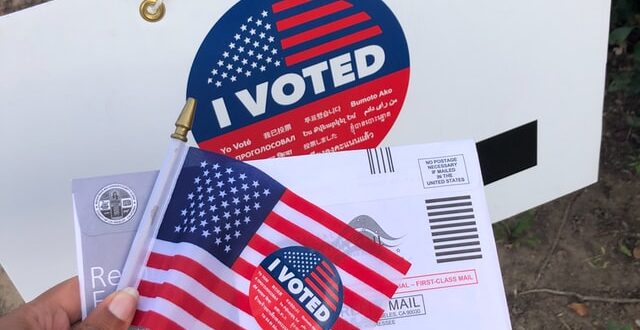
Among other provisions, ballot envelopes would have to meet specific design and automation standards, including voter-specific Intelligent Mail barcodes. Election officials would also have to submit ballot-envelope designs to USPS for approval.
Officials would then be required to upload information about voters receiving mail ballots, including names, addresses and individualized barcodes, to a new USPS online system.
Postal workers would use the information to verify ballot mail. Under the rule, mailings that fail to meet the requirements could be rejected and returned to election offices.
Opponents say the changes were imposed too close to the election for states to redesign systems, print compliant envelopes and establish new procedures without risking disruption.
Talwani cited those timing concerns when she issued her preliminary injunction, noting that the final USPS rule was published less than 70 days before the Nov. 3 election.
Supreme Court Now Has the Final Say
The First Circuit ruling does not end the case.
The Trump administration has already asked the Supreme Court to stay Talwani’s injunction while the broader legal challenge proceeds.
The administration initially filed an emergency application Sept. 3 but withdrew it and submitted a new application, docketed as 26A305, after Talwani issued her preliminary injunction Sept. 4.
Justice Ketanji Brown Jackson ordered opponents to respond by 4 p.m. Sept. 9. Multiple states, election officials, voting organizations and other groups filed responses and amicus briefs with the court.
The Supreme Court previously intervened in an earlier phase of the dispute, lifting a lower-court injunction involving the administration’s executive order. But the justices made clear that their earlier ruling did not establish that the eventual USPS rule would necessarily be lawful.
That distinction is now central to the case.
The administration is asking the justices to allow the rule to operate while the litigation continues. Opponents want the injunction to remain in place through the election.
Election Officials Warn of Disruption
The dispute comes as states begin sending mail ballots to voters.
North Carolina began mailing ballots earlier this month, with other states following on a rolling schedule. The administration has argued that allowing the injunction to remain in place could create confusion because states and USPS would not know whether they ultimately must comply with the new requirements.
Opponents counter that forcing states to implement an entirely new federal system at this stage of the election creates a greater risk.
The Supreme Court’s eventual decision could therefore determine whether states must alter their mail-ballot procedures weeks before Election Day.
A Broader Fight Over Federal Election Power
The case also represents a broader constitutional dispute over how much authority the executive branch has over the administration of federal elections.
The Trump administration says the USPS requirements are primarily postal regulations designed to protect election mail and prevent fraud.
Opponents argue that the rules effectively impose new election procedures on states without congressional authorization.
The First Circuit sided with the latter argument at this stage of the litigation, concluding that the administration had not shown a sufficient likelihood of success or demonstrated that Talwani’s injunction should be lifted.
The Supreme Court must now decide whether to allow the rules to take effect while that legal dispute continues.
With ballots already moving through the election system, the timing leaves little room for delay.