

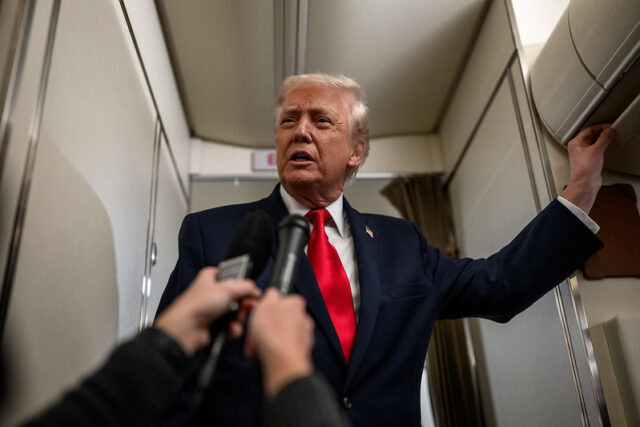
President Donald Trump announced Friday that the United States had reached an unprecedented agreement with Venezuela giving a new U.S.-backed venture majority control over more than 65 billion barrels of proven oil reserves — a deal Trump immediately declared the “biggest oil deal in world history.”
But while Trump is portraying the agreement as a massive expansion of American energy power that will lower gasoline prices, important details about the arrangement remain unclear, including how quickly the oil can be produced, who will finance the massive infrastructure overhaul Venezuela needs and exactly how the deal will work.
Trump announced the agreement in a Truth Social post, saying Secretary of State Marco Rubio and Secretary of War Pete Hegseth negotiated the deal with Venezuela’s interim President Delcy Rodríguez and private businesses.
“At my direction,” Trump wrote, the United States had “secured majority U.S. control of more than 65 BILLION BARRELS of proven Oil Reserves in Venezuela, at no cost to the American Taxpayer.”
The administration has not publicly released the full text of the agreement.
According to details that have emerged, the arrangement involves a new company formed by the U.S. government and an unnamed private operator that will receive long-term rights to develop 17 Venezuelan oil fields. Rodríguez’s government says those fields have a proven potential of roughly 65 billion barrels and that the agreement could attract nearly $100 billion in private investment.
The United States would hold an effective majority stake in the venture, including an estimated 55% share of its oil output. The Venezuelan government would also receive substantial tax revenue from the development.
The deal marks a dramatic expansion of U.S. involvement in Venezuela’s oil industry and comes less than eight months after the U.S. military captured former Venezuelan President Nicolás Maduro and brought him to the United States to face federal narcoterrorism and drug trafficking charges.
Trump promises cheaper gas and more American oil
Trump said the agreement will more than double U.S. oil reserves and “substantially lower Gas Prices for all Americans.”
Rubio echoed that argument, calling the agreement a “huge win” for both countries.
“It demonstrates how President Trump’s bold foreign policy is driving America First wins,” Rubio wrote, saying the deal would secure stable oil supplies, attract nearly $100 billion in private investment and create thousands of jobs in Venezuela.
For Venezuela, Rodríguez’s government has described the agreement as a way to rebuild an oil industry that has been crippled by years of underinvestment, political turmoil and deteriorating infrastructure.
But the promise of cheaper gasoline may not arrive quickly.
Venezuela has the world’s largest proven crude oil reserves, estimated at roughly 303 billion barrels. Yet its oil production has collapsed far below its potential because of aging infrastructure, limited investment and years of economic and political instability.
Reviving that production will require enormous amounts of capital and years of development.
The Washington Post reported that experts have questioned how quickly the reserves could actually be brought online and who will pay the enormous costs required to develop the fields.
The U.S. is not simply taking Venezuela’s entire oil supply
Trump’s description of the agreement as the United States taking control of 65 billion barrels obscures an important distinction.
The 65 billion barrels represent the estimated proven potential of 17 Venezuelan fields covered by the agreement. The arrangement gives a new venture long-term rights to develop those fields rather than transferring ownership of every barrel of Venezuelan oil to the U.S. government.
The venture is expected to have 100-year development rights, according to officials familiar with the agreement.
The United States would receive an effective majority of the venture’s output, while Venezuela would retain a financial interest through taxes and other revenue generated by production.
The arrangement nevertheless represents an extraordinary expansion of U.S. influence over Venezuela’s energy resources.
It also comes after Trump repeatedly said the United States should take greater control over Venezuela’s oil industry following Maduro’s removal.
Why Venezuela’s oil matters
Venezuela sits on an extraordinary amount of crude.
The country has an estimated 303 billion barrels of proven reserves — more than any other country in the world.
But having oil underground is not the same as being able to produce it.
Venezuela’s production capacity has deteriorated dramatically. Much of its infrastructure is outdated, damaged or poorly maintained, leaving the country capable of producing only a fraction of the oil its reserves could theoretically support.
That makes investment the central question surrounding Trump’s announcement.
The agreement could bring tens of billions of dollars into Venezuela’s energy industry, but rebuilding fields, pipelines, refineries and other infrastructure will take time.
The United States therefore may gain greater access to Venezuelan crude long before American drivers see a major impact at the pump.
A deal with major political stakes
The timing is also significant.
Trump is facing the November midterm elections with gasoline prices elevated amid the ongoing war with Iran. His administration has repeatedly emphasized energy security and lower fuel costs as central economic priorities.
A major Venezuelan oil agreement gives Trump an opportunity to argue that his foreign policy is producing a direct benefit for American consumers.
But the economic payoff remains uncertain.
Even if production increases substantially, Venezuela’s heavy crude requires specialized infrastructure and refining capacity. Increasing supply will also depend on how quickly private companies are willing to invest billions of dollars in a country whose political and legal systems have been deeply unstable.
That means Trump’s promise of dramatically lower gas prices is likely to face a longer timeline than his announcement suggests.
Questions remain over the deal’s legality and terms
The agreement could also face legal and political scrutiny inside Venezuela.
The full text of the arrangement has not been publicly released, leaving unanswered questions about ownership, investment obligations, revenue sharing and the legal authority behind the long-term concessions.
Critics have questioned whether the deal serves Venezuela’s interests or gives the United States and private companies too much control over the country’s most valuable natural resource.
The political circumstances surrounding the agreement make those questions even more consequential.
Trump’s administration is negotiating with Rodríguez after the U.S. military removed Maduro from power and brought him to the United States.
That history makes the oil agreement more than a conventional energy transaction. It is also part of a broader U.S. effort to reshape Venezuela’s political and economic future.
What happens next
The immediate challenge will be turning the announcement into actual production.
Private companies will need to commit enormous sums to rebuilding Venezuela’s oil infrastructure. Regulators and governments will need to finalize the legal and financial framework. And the new venture will have to demonstrate that it can operate in an industry that has suffered years of decline.
Trump is already selling the agreement as an American energy breakthrough.
“This Historic Transaction MORE THAN DOUBLES American Oil Reserves,” he wrote, while promising increased supply and lower gas prices.
But the deal’s ultimate significance will depend less on the size of the oil reserves on paper than on how much crude can actually be produced, how quickly it can reach global markets and how much of the economic benefit reaches American consumers.
For now, Trump has announced one of the largest U.S. energy commitments in decades.
The harder part will be making the oil flow.