Poli Alert Politics & Civics
Related Articles
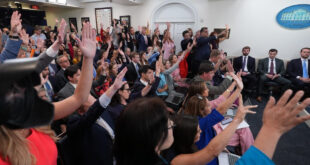
The U.S. Senate adjourned for its summer recess early Saturday after approving a stopgap spending bill but declining to advance legislation that would require photo ID for voting.
In a rare overnight session that began on Friday, senators trudged through a slew of measures, confirmed President Donald Trump’s nomination of Todd Blanche as attorney general and then departed the nation’s capital for the coveted August recess. The chamber is not expected to return to regular session until after Labor Day.
The Senate passed, 86-11, a major effort first proposed by the late GOP Sen. Lindsey Graham of South Carolina that would impose sanctions on Russian President Vladimir Putin, along with the country’s oligarchs and military leaders.
A bipartisan education bill — championed by GOP Sen. Susan Collins of Maine and Democratic Sen. Michael Bennet of Colorado — served as the vehicle for the Russia sanctions package.
Collins’ and Bennet’s bill would ensure that “early childhood educators can claim the same federal tax credit for out-of-pocket classroom supply purchases that is currently available to K-12 teachers,” per a press release.
Averting a shutdown
The Senate also passed a bipartisan measure on a 90-6 vote that would keep the federal government funded through Dec. 11. The House has passed a different version so the two would have to be reconciled.
Earlier in the day, senators had advanced the legislation, known as a continuing resolution, toward a final vote on another strongly bipartisan vote of 91-6.
Senators did not vote on a proposed blueprint that would unlock the complex budget reconciliation process and allow Republicans to move ahead on their third party-line bill.
Attorney general vote
The upper chamber also confirmed Blanche, the acting attorney general, to be the next U.S. attorney general.
Sen. Bill Cassidy of Louisiana marked the determinative vote amid GOP opposition from Collins and Sen. Lisa Murkowski of Alaska over Blanche’s bid, as well as the absence of Republican Sen. Mitch McConnell of Kentucky, who’s recovering from a health issue.
The Senate confirmed a batch of nominees earlier Friday, including Cameron Hamilton to serve as the next administrator for the Federal Emergency Management Agency, 51-47.
Voting and photo ID
The Senate failed to advance on a 52-46 vote a bill that would require a photo ID to vote in an election to federal office.
Related to the separate SAVE America Act, it was sponsored by Republican Sen. Jon Husted of Ohio. Sixty votes were required to move ahead on the measure, which was opposed by all Democrats voting.
Democrats have said in the past such a requirement would make it more difficult for all Americans to vote.
Sen. Mike Lee, R-Utah, a proponent of photo ID and the SAVE America Act who at one point had said he would hold up adjournment to obtain action, vowed afterward to continue pushing for it. “This fight’s not over. We’re just getting started,” he said.
Trump is an intense proponent of the SAVE America Act and urged the Senate to stay in town to pass it though Republican leaders have said repeatedly there are not 60 votes to do so. The SAVE America Act would require voters to show proof of citizenship when they register and a photo ID when they vote. Noncitizens are already barred from voting in state, federal and almost all local elections.
College sports
The Senate did not take a procedural vote before leaving town on a sweeping bipartisan bill that would set national standards for college athletes’ compensation.
GOP Sen. Ted Cruz of Texas and Democratic Sen. Maria Cantwell of Washington state — the top members of the Senate Commerce panel, which has jurisdiction over the matter — introduced the bill, with GOP Sen. Eric Schmitt of Missouri and Democratic Sen. Chris Coons of Delaware as original co-sponsors.
The bill underwent several changes after it was passed by the Commerce panel in June, and was able to ultimately garner the support of the formidable Big Ten and Southeastern conferences.
But the Congressional Black Caucus opposed the legislation in a statement earlier this week, noting that “at the very moment that Black political representation is under attack across the country, we will not be complicit in efforts to further exclude the interests of Black people by advancing legislation that will determine the economic future of Black athletes, their families, and their communities without their meaningful participation and engagement.”
President Donald Trump, who’s thrown his support behind the measure, urged the Senate earlier Friday evening to stay in town until the bill passes.
“Stop grandstanding, and try getting this done,” he wrote in a social media post.
By Shauneen Miranda, News From The States