Poli Alert Politics & Civics
Related Articles


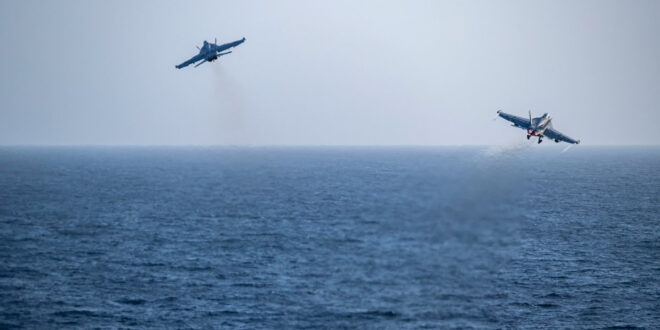
The United States launched a new wave of military strikes against Iran-backed targets Wednesday after President Donald Trump vowed a forceful response to renewed attacks on American forces in the Middle East, dramatically escalating tensions that had briefly eased during diplomatic efforts.
U.S. Central Command (CENTCOM) said a “heavy wave of strikes” concluded around 10 p.m. ET after targeting dozens of locations tied to Iran and its regional proxy network. Military officials said the operation was intended to reduce threats to U.S. forces, commercial shipping and allied Gulf nations.
“The strikes aimed to further diminish threats posed by Iran and its proxies to American forces, commercial shipping, and neighboring Gulf countries,” CENTCOM said in a statement posted on X.
The military action followed what U.S. officials described as a “surprise attack” on American forces in the region. According to CENTCOM, U.S. air defenses intercepted Iranian missiles fired toward American installations Tuesday evening, preventing casualties while troops remained on heightened alert.
President Donald Trump, speaking after the attacks, signaled a major military response. Fox News chief foreign correspondent Trey Yingst reported that Trump said Iran was “going to get a beating” after previously warning he would “beat the f—ing s— out of” the country if hostilities continued.
Iran Claims Responsibility
Iran’s Islamic Revolutionary Guard Corps (IRGC) claimed responsibility for missile strikes targeting a U.S. air base and military command center in Jordan, according to Iran’s state-run Nour News agency.
Iran’s navy also reportedly seized three oil tankers it accused of violating Tehran’s blockade of the Strait of Hormuz, according to the state-run IRNA news agency.
Iran had largely suspended military operations in recent days while indirect diplomatic contacts with Washington resumed. However, Iranian officials warned this week they would not allow the United States to dictate the “timing of war and peace” and insisted the Strait of Hormuz remained closed under Tehran’s blockade.
U.S. Expands Military Response
Hours after intercepting Iranian missiles, CENTCOM announced additional precision strikes conducted alongside Saudi forces against what it described as Iran-directed militant infrastructure inside Iraq.
The command said the targets included logistics hubs and weapons facilities used by militias allegedly responsible for more than 30 drone attacks against U.S. forces over the previous 72 hours.
CENTCOM did not identify the specific militant groups involved.
The Popular Mobilization Forces, an umbrella organization that includes several Iran-aligned Shiite militias, acknowledged that multiple headquarters had been struck, calling the attacks a violation of Iraqi sovereignty and reporting that several members had been killed.
“The IRGC and its terrorist proxies must cease these attacks to avoid further U.S. military response,” CENTCOM said.
Saudi Arabia separately affirmed its support for defensive operations while emphasizing it does not seek broader regional escalation.
Diplomatic Efforts Collapse
The renewed fighting interrupted another attempt to restart diplomacy between Washington and Tehran.
Earlier this week, Trump said aboard Air Force One that he believed there was “a chance we can make a deal,” expressing optimism that negotiations could prevent further conflict.
It marked the latest instance in which hopes for diplomacy were overtaken by renewed military action.
Trump has previously alternated between threatening major strikes against Iran and expressing confidence that negotiations could succeed. Earlier Tuesday, he told Fox News that if diplomacy failed, the United States would “finish the job.”
Oil Markets React
Global energy markets reacted immediately to the renewed conflict.
Oil prices climbed Wednesday as investors weighed the risk of prolonged disruptions to shipping through the Strait of Hormuz, a strategic waterway that previously carried roughly one-fifth of the world’s oil supply.
The conflict has also expanded beyond the Persian Gulf. Iran-backed Houthi forces in Yemen recently announced a blockade targeting Saudi Arabia, adding pressure to maritime traffic through both the Strait of Hormuz and the Bab el-Mandeb.
Questions Over U.S. Military Resources
The latest military campaign comes as questions persist about the pace of U.S. operations in the region.
NBC News previously reported, citing senior officials, that U.S. commanders had conserved portions of their missile inventory by allowing some lower-priority Iranian attacks to be intercepted through layered defenses rather than using more expensive munitions.
Trump administration officials have disputed those concerns.
U.S. Ambassador to the United Nations Mike Waltz said Sunday that American forces possess all the military resources necessary to sustain operations against Iran, dismissing reports of dwindling weapons stockpiles.
The renewed strikes underscore the increasingly fragile security situation across the Middle East as diplomatic negotiations continue to compete with expanding military operations involving Iran, the United States and regional allies.