Poli Alert Politics & Civics
Related Articles


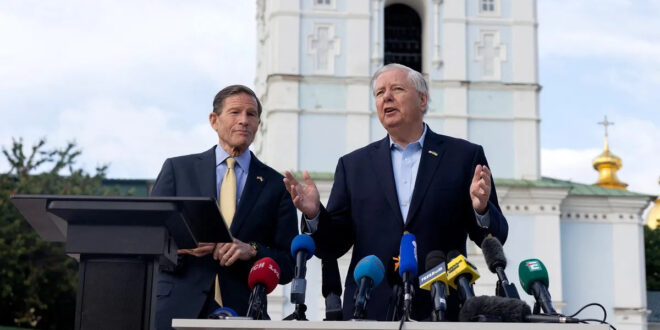
The Senate voted overwhelmingly Tuesday to advance a bipartisan sanctions package targeting Russia, moving forward legislation renamed in honor of the late Sen. Lindsey Graham after his unexpected death.
Senators approved the procedural motion 86-12, clearing the way for final passage later this week.
The vote came just hours after Ukrainian President Volodymyr Zelenskyy addressed senators on Capitol Hill and soon after lawmakers attended Graham’s funeral. The South Carolina Republican had been one of Congress’ most vocal supporters of Ukraine throughout Russia’s invasion.
Momentum behind the legislation accelerated following Graham’s death, with senators from both parties pushing to pass the measure as part of his legislative legacy.
The bill would impose new sanctions on senior Russian officials, the country’s energy sector and Russia’s so-called shadow fleet of ships used to transport oil while evading existing international sanctions. It also extends certain sanctions against Iran after lawmakers agreed Tuesday to broaden the legislation’s scope.
The measure now has 62 bipartisan co-sponsors and is expected to pass the Senate. Its future in the House, however, is less certain after lawmakers adjourned for the August recess before taking up the legislation.
Graham and Sen. Richard Blumenthal, D-Conn., spent more than a year building support for the sanctions package after introducing it in April 2025.
The legislation faced repeated delays as the White House sought broader presidential discretion over which foreign entities would face sanctions and how aggressively those penalties would be enforced.
Just days before his death, Graham announced from Kyiv that he had secured White House approval for revised legislation following negotiations with the administration.
The updated version expands mandatory sanctions to include additional Russian entities, particularly ships operating in Moscow’s shadow oil fleet, while also giving Trump broad authority to waive certain sanctions.
One of the bill’s most significant provisions would authorize tariffs on countries that continue purchasing large volumes of Russian energy exports, an effort designed to pressure Moscow’s largest customers to reduce their dependence on Russian oil and gas.
That provision drew criticism from some Democrats who argued Congress should not expand Trump’s tariff powers.
“It is extremely dangerous to give Trump massive new tariff powers, particularly after we’ve seen the disastrous impacts of his corrupt, chaotic, and inflationary tariff spree,” House Ways and Means Committee Ranking Member Richard Neal, D-Mass., and Senate Finance Committee Ranking Member Ron Wyden, D-Ore., said in a joint statement.
Despite those concerns, only 11 Democrats joined Republican Sen. Rand Paul of Kentucky in opposing Tuesday’s procedural vote.
Senate Minority Leader Chuck Schumer, D-N.Y., said advancing the legislation sends a clear signal to Russian President Vladimir Putin.
“The United States stands by Ukraine,” Schumer told reporters, adding that Congress was demonstrating Putin “can’t bully Ukraine.”
The White House also endorsed the revised measure. Earlier this month, Trump urged Republicans to include sanctions related to Iran, saying it reflected Graham’s priorities.
Lawmakers ultimately agreed to include the Iran provisions after determining they merely extend existing sanctions rather than creating significant new restrictions.
If approved by the Senate later this week, the bill will await House action when lawmakers return from recess.