

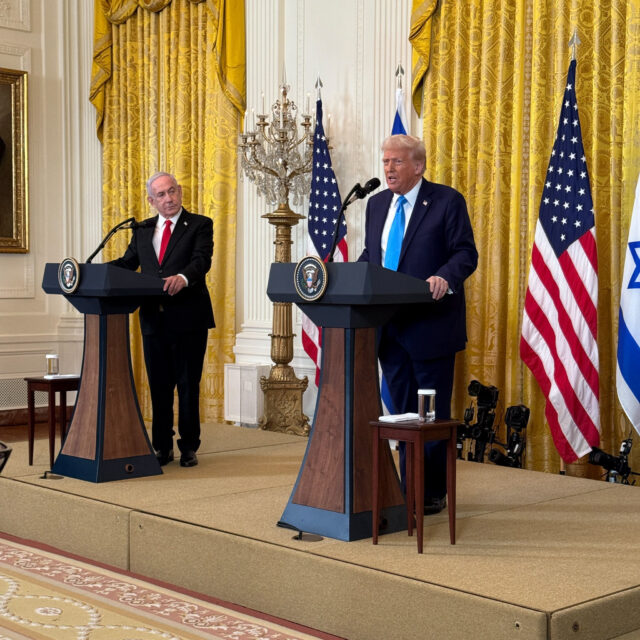
The House approved a sweeping defense policy bill Wednesday that would significantly expand military cooperation between the United States and Israel, drawing objections from several Democrats who argued the legislation moves the two nations toward deeper military integration.
Lawmakers approved the National Defense Authorization Act (NDAA) for fiscal year 2027 by a 216-212 vote. The legislation authorizes more than $1 trillion in defense spending and now heads to the Senate before eventually reaching President Donald Trump’s desk.
A provision known as Section 219 has emerged as one of the bill’s most closely watched components because it would formalize and expand joint military research, weapons development and technology sharing between the Pentagon and Israel.
Under the proposal, the Defense Department would establish a senior coordinator responsible for accelerating joint research, testing and deployment of military technologies developed with Israel. The coordinator would also oversee how jointly developed systems could be integrated into U.S. military operations and identify technologies suitable for production by American defense contractors.
The legislation directs expanded cooperation on a broad range of military capabilities, including air defense systems, counter-drone technology, artificial intelligence, quantum computing, cyber operations, electronic warfare, biotechnology, advanced sensors and underground warfare technologies. It also encourages additional joint military exercises and greater interoperability between U.S. and Israeli defense systems.
Supporters say the measure strengthens America’s technological edge while reinforcing one of its closest security partnerships in the Middle East.
The American Israel Public Affairs Committee (AIPAC) has backed the provision, arguing it will help both countries develop next-generation defense systems while improving battlefield capabilities for U.S. forces.
Several Democrats, however, warned the language could blur the lines between the two militaries.
Rep. Alexandria Ocasio-Cortez, D-N.Y., argued the proposal risks merging portions of the U.S. military with the Israel Defense Forces, calling it a threat to American sovereignty.
Rep. Ro Khanna, D-Calif., and Rep. Thomas Massie, R-Ky., also voiced opposition to expanded military integration with Israel. Massie previously proposed ending more than $3 billion in annual U.S. military assistance to Israel, though that amendment failed in the House.
The legislation does not create a joint U.S.-Israeli military force, place American troops under Israeli command or obligate either nation to fight on the other’s behalf. Instead, it focuses on expanding defense technology cooperation and information sharing.
Defense Secretary Pete Hegseth would be required to submit an initial report to Congress within 180 days detailing implementation of the expanded partnership, followed by annual reports through 2030 evaluating its impact on U.S. national security.
The broader defense package also comes as the Trump administration continues military operations against Iran. Hegseth recently said the conflict has cost the United States roughly $37.5 billion since late February.
The Senate is expected to take up its version of the NDAA in the coming weeks. Differences between the House and Senate bills would need to be reconciled before the legislation can be sent to the president for signature.