Poli Alert Politics & Civics
Related Articles



President Donald Trump’s name was removed from the facade of the Kennedy Center on Saturday, ending a controversial effort to rebrand one of the nation’s most prominent cultural institutions after a federal judge ruled the move violated federal law.
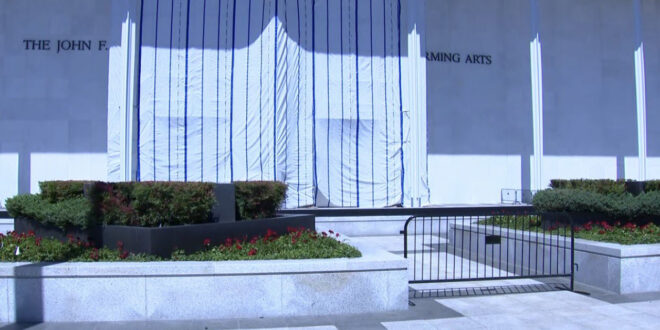
In a court filing submitted Saturday to the U.S. District Court for the District of Columbia, Kennedy Center Chief Operating Officer and Executive Director Matthew Floca confirmed that crews had removed “all physical signage” from the building and surrounding grounds that sought to rename the institution after Trump or any individual other than President John F. Kennedy.
The removal followed a court-ordered deadline that had originally expired Friday. Floca said weather-related delays pushed the work into Saturday morning. Workers concealed the project behind a large white tarp while removing Trump’s name from the building’s exterior.
The development marks a significant setback for Trump’s efforts to reshape the historic performing arts venue after installing allies in leadership positions and pursuing an ambitious overhaul of the institution.
Court Rejects Trump Rebranding Effort
The removal stems from a ruling issued in late May by U.S. District Judge Christopher Cooper, who determined that the administration’s attempt to rename the Kennedy Center violated federal law and exceeded executive authority.
Cooper ruled that Congress alone has the power to alter the name of the federally chartered institution and that the venue was legally designated to honor President Kennedy. The judge found that efforts to rename the center after Trump improperly bypassed congressional authority.
In addition to ordering the removal of Trump’s name, Cooper blocked plans to close the Kennedy Center for a two-year renovation project that administration officials had promoted as part of a broader modernization effort.
The administration and the Justice Department sought emergency stays from both Cooper and a federal appeals court, but both requests were denied before the deadline.
According to Floca’s filing, the Kennedy Center has spent recent weeks reversing changes made during the rebranding effort.
Officials removed references to Trump from the institution’s website, updated employee email signatures, issued new identification badges, and withdrew trademark applications that would have formally incorporated Trump’s name into the center’s branding.
The changes restored the institution’s official identity as the John F. Kennedy Center for the Performing Arts.
The decision represents a sharp blow to Trump, who had envisioned a sweeping transformation of the venue after returning to office.
The president’s plans included restructuring the board with loyal supporters, launching extensive renovations, and expanding his influence over the center’s artistic direction and programming.
Following Cooper’s ruling in May, Trump publicly criticized the decision and suggested he might abandon efforts to reshape the institution altogether.
“Judge Cooper should be ashamed of himself!” Trump wrote on Truth Social. “Unless I am free to do what I do better than anyone else, bring this Institution back, physically, financially, and artistically, I have no interest in continuing what could only be a hopeless journey.”
The dispute has become one of the most visible clashes between the Trump administration and the nation’s cultural institutions.
Supporters argued that Trump’s leadership would revitalize the Kennedy Center financially and artistically. Critics contended that the effort politicized a national arts institution and ignored legal safeguards governing its operation.
With Trump’s name now removed and court challenges exhausted for the moment, the Kennedy Center returns to its original designation, though the broader debate over politics and cultural institutions is likely to continue.