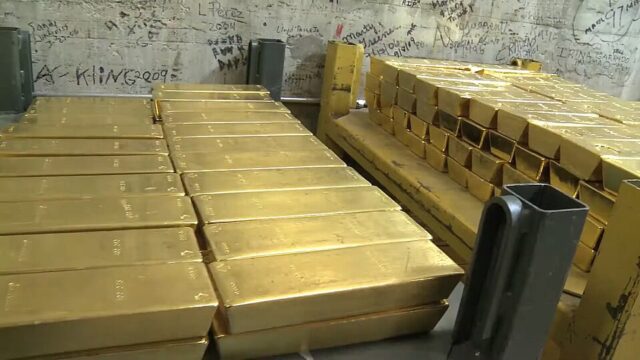
Gold sold by the United States Mint as “American” may, in part, originate from foreign mines, recycled jewelry and regions tied to criminal activity — despite a federal law requiring the use of domestically mined gold, according to an investigation by The New York Times.
The findings challenge one of the core assurances behind the Mint’s multibillion-dollar bullion program: that each coin reflects a fully domestic supply chain backed by the U.S. government.
Instead, the report outlines a system in which gold is sourced globally, melted and recast in the United States — effectively obscuring its origins before it is stamped into coins marketed as American.
Congress mandated in 1985 that the Mint use only U.S.-mined gold, aiming to shield government-backed bullion from foreign supply chains linked to human rights abuses, corruption and geopolitical risk.
Today, the Mint sells more than $1 billion in gold coins annually, attracting investors seeking stability during economic uncertainty.
But the investigation found that gold entering the Mint’s pipeline frequently passes through international markets before reaching U.S. refiners. In many cases, that includes material from Latin America, Africa and secondary sources such as pawned or recycled gold.
Because gold is routinely melted and mixed during refining, its original source can become difficult — and sometimes impossible — to trace.
At the center of the issue is whether the Mint’s sourcing practices comply with federal law or exploit a gap between statutory language and industry practice.
The Mint has argued in past reviews that suppliers can offset foreign gold by purchasing equivalent amounts of U.S.-mined material. However, a 2024 inspector general audit found the agency did not consistently verify suppliers’ sourcing or enforce that requirement.
The audit also noted that for years, the Mint did not require suppliers to disclose where their gold originated — limiting its ability to ensure compliance.
Legal experts say the law was designed to prevent precisely the kind of supply chain ambiguity now under scrutiny.
Treasury Secretary Scott Bessent said the department has launched a review of the Mint’s procurement practices.
“This review is focused on ensuring that the U.S. Mint’s gold suppliers comply with the law,” Bessent said in a statement.
After initially stating that its gold was entirely sourced from the United States, the Mint later described domestic supply as its “primary” source when confronted with the investigation’s findings.
Officials said tracking gold through complex global supply chains presents challenges, particularly given strong demand and limited domestic production.
The findings have intensified scrutiny of the gold industry, where tracing origin is notoriously difficult once material is refined and commingled.
Industry participants often rely on documentation from suppliers, but experts say those records can mask underlying risks — especially in regions where mining is linked to informal economies or criminal groups.
In Colombia, for example, gold mining has been associated with organizations such as the Clan del Golfo, which U.S. officials have designated as a terrorist group. Analysts warn that once such gold enters formal markets, it can be nearly indistinguishable from legally sourced material.
The controversy comes as gold prices surge to historic highs, driven by global instability and investor demand. Analysts say rising prices have increased incentives for illicit mining, environmental degradation and exploitation in vulnerable regions.
Gold has also become a financial lifeline for sanctioned governments and armed groups, further complicating efforts to ensure ethical sourcing.
At the same time, investors continue to view government-issued coins as among the safest ways to hold physical gold — a perception that relies heavily on trust in sourcing standards.
Treasury officials have not said when the review will conclude or whether enforcement actions or policy changes could follow.
The Mint has yet to release updated sourcing guidelines, despite prior audit recommendations.
As scrutiny grows, the investigation raises broader questions about transparency in government-backed commodities — and whether assurances tied to national branding can withstand the realities of a globalized supply chain.