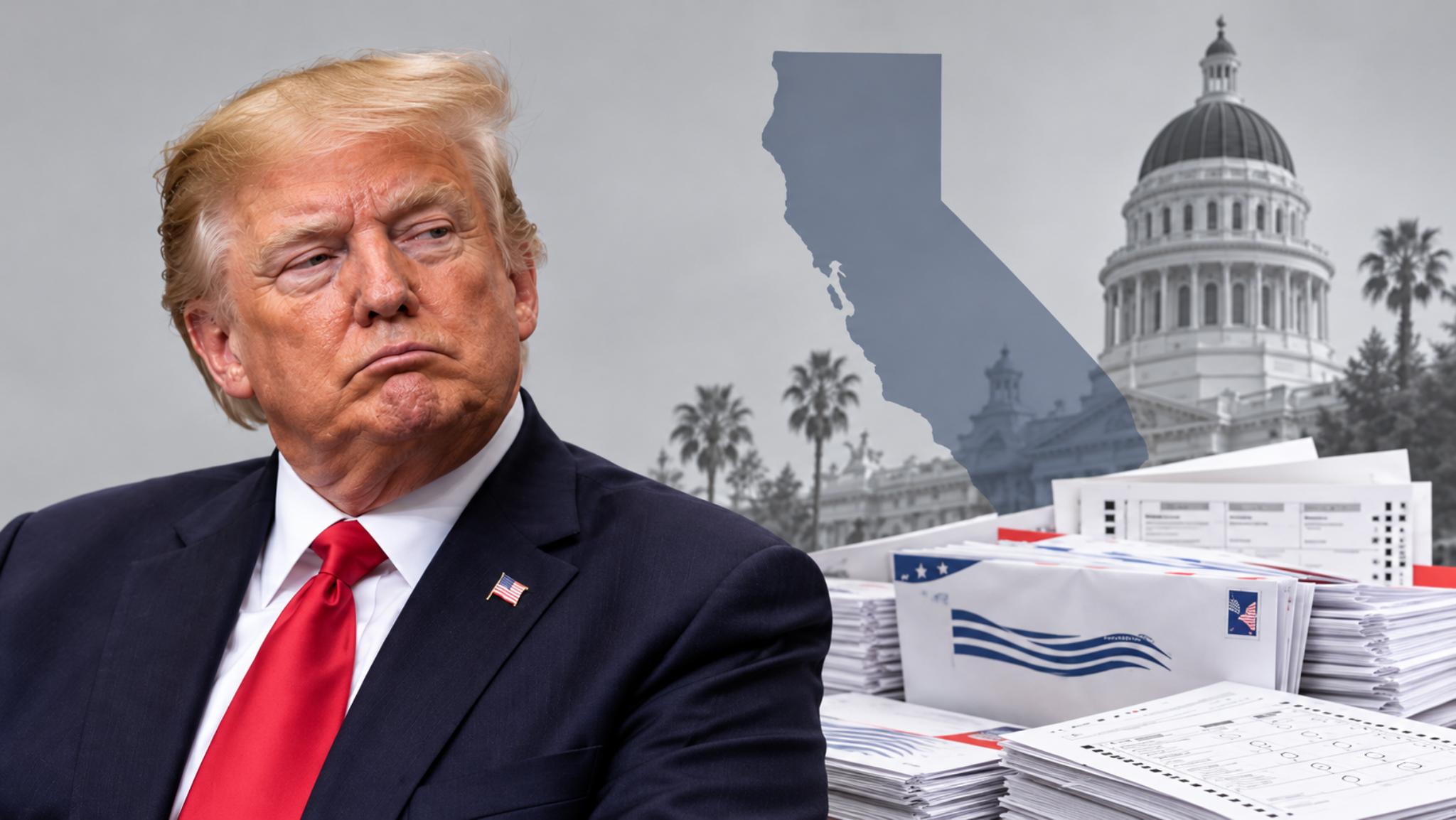
A federal judge on Wednesday rejected the Trump administration’s attempt to block 20,000 California ballots from being counted, handing the Justice Department a sharp loss less than a week before the November 3 midterm elections.
U.S. District Judge David O. Carter denied the Justice Department’s request for a temporary restraining order, which is an emergency court order meant to stop something from happening right away while a case plays out. The DOJ wanted California and Los Angeles County to pull aside and hold mail ballots returned by roughly 20,000 registered voters the administration claims are “likely” noncitizens, and not count them until each person’s citizenship could be verified.
Carter did not hold back. “Never before in American history has the federal government, on the eve of an election, sought to coerce a state and local government to abandon their own Constitutional elections procedures and bend to the will of the Executive Branch,” he wrote.
He also made clear what was at stake for everyday voters. “This request violates longstanding constitutional principles mandating that states have control over their elections,” Carter wrote. “If Plaintiff’s last minute request for relief were granted, either party could create chaos for their own political purposes to disrupt the election process. Over 20,000 registered Californians would potentially lose the right that generations of Americans have fought to preserve.”
The fight started in early October. California mailed ballots to registered voters on October 1, as state law requires. On October 13, the Justice Department sent state and county officials a list of more than 20,000 people it said were likely noncitizens and demanded that officials verify their citizenship within 48 hours or set their ballots aside. When California refused, the DOJ sued the state, Secretary of State Shirley Weber, and Los Angeles County Registrar Dean Logan. According to Logan’s office, 7,035 of the names on the list are in Los Angeles County.
California and Los Angeles County pushed back hard on the list itself. The county reviewed a sample of 200 names and found that 112 of those registrations were already inactive or canceled, and more than 70 percent of the people sampled had no voting history in California at all. The county also said about 1 in 4 people in its sample were listed as born in the United States. The Justice Department disputes that, saying its own immigration records review found none of the people it matched from the county’s sample were born in the U.S. The administration describes its list as the product of identity matching, immigration record reviews, and law enforcement screening.
The DOJ also tried to rush the courts. After Carter scheduled a hearing for October 27, federal lawyers demanded he rule by noon the next day, giving him about 15 hours. When he did not, the department went straight to the Ninth Circuit Court of Appeals before Carter had even ruled. On Monday, a three judge appeals panel turned the DOJ away in a 2 to 1 vote, saying the department had come to them too early and needed to wait for the trial judge. Judge Patrick Bumatay, a Trump appointee, dissented.
That sent everything back to Carter’s courtroom on Tuesday for a hearing that ran more than three hours. Bill Essayli, the top federal prosecutor in the Los Angeles area, argued the government had found credible evidence of noncitizens registered to vote by mail and claimed state and county officials allowed lawful and unlawful ballots to be mixed together. Federal officials had also warned county election workers they could face criminal exposure for continuing to process ballots from people on the list.
Carter shut that down before he even ruled. “This court believe that it would be wise that any threats to state and county election employees cease immediately,” he told the DOJ at the end of the hearing.
The judge also pointed to a simpler path. Federal law already makes it a crime for noncitizens to vote in federal elections, and Carter noted the government can go after anyone who votes illegally through prosecution. California’s ballot cure deadline is December 3. A ballot cure is the window when election officials contact voters to fix problems with their ballots, like a missing or mismatched signature, before the count is final. “We can clean that up before December 3,” Carter said.
Carter is not new to this fight. In January, he threw out a separate Justice Department lawsuit that tried to force California to hand over its unredacted voter rolls, meaning the full voter list with sensitive personal information included. In that case, he ruled the department was trying to go beyond the authority Congress gave it.
The numbers show why election officials said freezing ballots now would cause chaos. More than 3 million ballots have already been cast across California, including more than 500,000 in Los Angeles County alone, according to figures cited in the case.
California is not the only target. Attorney General Todd Blanche has threatened similar lawsuits against live ballots in a number of states, and the administration sent Washington state a demand to hold ballots from more than 400 people it accused of being noncitizens illegally registered to vote. Los Angeles County warned the court that a win for the DOJ here would mean any federal agency with a list could stop the count in any county in the country.
For now, California’s ballots keep getting counted. The Justice Department is expected to take the fight back to the Ninth Circuit, but as of Wednesday, the 20,000 voters on the administration’s list remain in the count.